Search the KHIT Blog

Wednesday, May 4, 2022

2022 Mother's Day greetings from Justice Alito

Mother's Day will now be mandatory. "It is so ordered."
JUSTICE ALITO delivered the (Dobbs v Jackson, leaked first draft] opinion of the Court.

Abortion presents a profound moral issue on which Americans hold sharply conflicting views. Some believe fervently that a human person comes into being at conception and that abortion ends an innocent life. Others feel just as strongly that any regulation of abortion invades a woman's right to control her own body and prevents women from achieving full equality. Still others in a third group think that abortion should be allowed under some but not all circumstances, and those within this group hold a variety of views about the particular restrictions that should be imposed.

For the first 185 years after the adoption of the Constitution, each State was permitted to address this issue in accordance with the views of its citizens. Then, in 1973, this Court decided Roe v. Wade, 410 U. S. 113. Even though the Constitution makes no mention of abortion, the Court held that it confers a broad right to obtain one. It did not claim that American law or the common law had ever recognized such a right, and its survey of history ranged from the constitutionally irrelevant (e.g. its discussion of abortion in antiquity) to the plainly incorrect (c.g, its assertion that abortion was probably never a crime under the common law). After cataloguing a wealth of other information having no bearing on the meaning of the Constitution, the opinion concluded with a numbered set of rules much like those that ‘might be found in a statute enacted by a legislature.’

Under this scheme, each trimester of pregnancy was regulated differently, but the most critical line was drawn at roughly the end of the second trimester, which, at the time, corresponded to the point at which a fetus was thought to achieve “viability,” ic., the ability to survive outside the womb. Although the Court acknowledged that States had a legitimate interest in protecting “potential life,” it found that this interest could not justify any restriction on pre-viability abortions. The Court did not explain the basis for this line, and even abortion supporters have found it hard to defend Roe's reasoning. One prominent constitutional scholar wrote that he “would vote for a statute very much like the one the Court ended up drafting ”if he were “a legislator,” but his assessment of Roe was memorable and brutal: Roe was “not constitutional law” at all and gave almost no sense of an obligation to try to be.” …

Roe was egregiously wrong from the start. Its reasoning was exceptionally weak, and the decision has had damaging consequences. And far from bringing about a national settlement of the abortion issue, Roe and Casey have enflamed debate and deepened division.

It is time to heed the Constitution and return the issue of abortion to the people's elected representatives. “The permissibility of abortion, and the limitations upon it, are to be resolved like most important questions in our democracy: by citizens trying to persuade one another and then voting.”…

…As we have explained, ‘procuring an abortion is not a fundamental constitutional right because such a right has no basis in the Constitution's text or in our nation's history…

VI
‘We end this opinion where we began. Abortion presents a profound moral question. The Constitution does not prohibit the citizens of each State from regulating or prohibiting abortion. Roe and Casey arrogated that authority. We now overrule those decisions and return that authority to the people and their elected representatives.

‘The judgment of the Fifth Circuit is reversed, and the case is remanded for further proceedings consistent with this opinion.

it is so ordered.
_______
 
98 pages of arrogant, disingenuous, cherry-picking, confirmation bias "argument." (Though, really, the latter third comprises simply a summary compilation of the various state suits seeking to overturn Roe and Casey.)

 
The vapid "Originalist / Textualist" assertion.
OK, there are 171,476 "active" words in the English language (per Oxford Dictionary). There are 7,591 words comprising the U.S. Constitution—Preamble through the 27th Amendment. Within those there are 1,153 discrete words, 555 of which appear only once. Pick any English word at random. The base probability of it not being in the Constitution is 99.7%.

apropos of this issue, a curious small sample of other words not to be found therein: explicit, implicit, male(s), woman, women, child, children, female(s), reproduction, reproductive, ovum, conception, contraception, pregnant, pregnancy, gestation(al), fetus, unborn, birth, childbirth, infant, baby, mother, personhood...

You (should) get the idea.

Phrases not found: Separation of powers, separation of church and state, co-equal branches, checks and balances, Unitary Executive...

Seriously, need we continue?
Justice Alito wants it both ways. Imagine my surprise. Who wouldn't? So, pro-choice advocates "must show that the right is somehow implicit in the constitutional text?" What part of the 14th Amendment "Equal Protection clause" clear, explicit language escapes you, sir? Yeah, I know, back during the time of the 14th Amendment debate, women were not regarded as "persons," right? They were politically "not part of our nation's history."
It was in fact argued in 1868 during Senate debate that that had been Framer James Madison's view.
Being at one demonstrably "pro-life and pro-choice," I've been posting on this issue for 14 years. As a male, I have misgivings about even proffering my opinion (but, my opinion is hardly grounded in philosophical abstractions).
 
No.

Cutting to the chase, a woman's reproductive decisions are no one else's business, male or female, individual or institutional. These decisions are not the legitimate turf of socio-politcal plebiscites, nor judicial interventions.
“How dare they? How dare they tell a woman what she can do and cannot do with her own body?” —Vice President Kamala Harris
And, I know full well we may lose that argument, politically. The adverse upshot will extend far and wide.
 
________

UPDATE
 
Yeah, he festooned his draft with enough window dressing to keep Ginni Thomas measuring the White House drapes for years
 
OK, what's the "logic" here? The "if/then/therefore/else" stuff?
 
And, yeah, I know Dobbs is not a "law." It's at this point a "legislative fetus."

We might also note the prior "case-law" references:
Heller, 509 U.S, at 319, 320
FCC v. Beach Communications, Inc., 508 U.S. 307, 313
New Orleans, 421 U.S, at 303
Williamson v. Lee Optical of Okla., Inc. 348 U.S. 483, 491
Gonzales, 550 U.S, at 157-158
Roe, 410 U.S. at 150
Glucksberg, 521 U.S., at 728-731
Of course, properly, we'd have to assess their materiality individually, in full. What "evidence" do they add? "You get what you inspect, not what you expect."
 
This type of exasperating pedantry comes from the tedious grad school "Argument Analysis and Evaluation" method. You first thoroughly and clearly establish what is being argued. Only subsequent to that deconstructive effort can you undertake to "evaluate" it.
The foregoing is from one paragraph. There are well in excess of 100 (not counting footnotes) in Alito-Dobbs.
Note that the foregoing assertive passage makes no mention whatsoever about the woman's right to physical and moral autonomy, which is apparently assumed to be subordinate, notwithstanding the charming cover-your-ass sop proffered in 3.2. (And, 3.6 simply leaves me scratching my head.)

Alito asserts [pg 9] that Roe “held that the abortion right, which is not mentioned in the Constitution, is part of a right to privacy, which is also not mentioned.”
 
Yeah, that insipid albeit hardy perennial "textualist" beg-off.
 
I am not a lawyer, and certainly make no claim to constitutional expertise broadly, but I will put my 4th Amendment chops up against his any day. e.g., two chapters from the online draft of my 283 pg 1998 graduate thesis: Chapter 4, and Chapter 5.
...While the word “privacy” admittedly appears nowhere in the text of the Bill of Rights, neither do the terms “obscenity,” “sodomy,” “pregnancy,” “sacred marital bedroom,” or “drug abuse.” Those who espouse a view of the Constitution as a document of broad moral principles find such lack of specificity compelling in their argument against simplistically limited textual “strict construction.” Indeed, the 9th Amendment—“The enumeration in the Constitution of certain rights shall not be construed to deny or disparage others retained by the people”—is universally cited by “broad construction” advocates to counter the observation that the specific term “privacy” is absent from the Constitutional language. To the “Constitution-of-Principle” advocate, the very brevity and generality of the Constitutional text is dispositive evidence that, far from being a document essentially no different than a commercial insurance contract, the “large-C” Constitution provides the general vision of justice and procedural guidelines for those who must administer ongoing the “small-c” constitution comprised of the very breadth of our social fabric..
C'mon, people.

"I think it [the Alito Dobbs draft opinion] is intellectual and historically bankrupt. The founding document did not list all of the rights we have. It doesn't say anything about our right to marry, our rights to decide how to bring up our children, our freedom to think what we will. It protects liberty in very broad terms. It protects equality.”


"This idea by Justice Alito -- he is backed by the right-wing of the court and by many right-wing activists, this idea that the Constitution protects only those rights that are listed and those rights that are rooted in a misogynist history that really did not take account of women at all. It is simply a prescription for turning the clock back, not just to the 1950s, but to the 1850s. It is a regressive approach, it is not consistent with our trajectory of constitutional rights, which have expanded and expanded."


   — Harvard Law Professor Emeritus Lawrence Tribe, on MSNBC

LAWYER & WRITER JILL FILOPOVIC
Demand more of men. Some men are out front of this issue; most of them are not. Where are the men in your life? Are they speaking out about how abortion rights have made their lives better, directly or indirectly? Are they only willing to support pro-choice politicians? Are they also protesting, making phone calls, talking about this with their friends, and donating their money? Are they as invested in this fight as you are? And if not — how much do they really value you, or women more generally? What role do you want them to play in your life? If you’re a man reading this, consider how abortion rights have affected you. If you got someone pregnant who had an abortion (and maybe that happened but you don’t know about it), how did that choice allow you to live the life you have now? If a loved one has had an abortion — and I promise you, someone you love has had an abortion — how did that allow her to live the life she has now? How have all of the ways in which abortion rights made women freer and safer improved your life and the lives of those you love?
Am I doing enough? Probably not.
 
JUST IN
Click here.
Just came to my attention via PBS Newshour. Kathryn Kolbert, Julie F. Kay. Bought it.
______
 
BTW, tangentially, broadly apropos,

 
SNL IS ON IT
 
 
CODA
Liberty No More
If Roe v. Wade is overturned, the very definition of what it means to be American will change for women and girls in the United States.
By Adrienne LaFrance

How strange it is, the condition of having a body, of being a body. Consider the sponge of the marrow that makes your blood, the skeleton frame that holds in your organs, the tendons that attach your muscles to bone, the heart that pumps blood through your veins, the electrical signals that travel along the optic nerve from your retinas, the neural networks that light up the galaxies of your brain like constellations.

A person’s interiority—your sense of youness—is typically understood to be situated in the mind, yet the mind and the body are inextricable. What, then, must it mean to be in possession of a body in America? This is, we are told, a land of tremendous abundance, of self-reliance, of liberty, and of invention. The promise America makes to its people, the covenant that we Americans can feel in our bones and in our blood and in our beating hearts, is the guarantee that we are free.

Liberty is given to us by God, by nature, by our own humanity—not by government. I am American and so I am free to speak, free to publish, free to worship, free to assemble, free to keep and bear arms. It is to me self-evident that I am free to pursue the life I choose, without interference from the state. Freedom of mind does not come without freedom of body.

If Roe v. Wade is overturned, as now appears likely, the very definition of what it means to be American will change for women and girls in the United States. If the state makes a claim to your body—a claim therefore to your self—you can no longer be American, not truly. To allow the state to control the body of a citizen is to deny her full personhood. To allow the state to control the body of a citizen is to undermine the very notion of what America is, the core promise it makes.

Abortion presents, as Justice Samuel Alito writes in his draft opinion in the Dobbs case, “a profound moral issue.” None of us can claim to understand with certainty the mysteries of human life. As medicine and science have advanced, the moral questions about abortion that we must contemplate have only grown more complicated. But none of that changes the fact that government control of women’s bodies—interference from the state that obliterates women’s freedom and in some cases ends their lives—represents a monumental blow to human rights…
Read all of it. Pay it forward. Below, one last report.
Republicans Are Wasting No Time Pushing Dystopian Post-Roe Laws
It’s gonna get so bad
Having all but won the SCOTUS abortion war—the GOP’s twisted, totalitarian worldview is being laid bare for the entire world to see.
Max Burns, Daily Beast


It’s only been a week since the explosive leak of a draft Supreme Court decision presaging the end of 50 years of legal abortion in America. But the GOP is wasting no time building its bleak, authoritarian successor state.


Having seemingly won their signal victory on abortion, Republicans do not have time for messy things like participatory democracy, only the raw exercise of power.


 What Republicans are planning goes far beyond ending legal abortion as defined in the landmark case Roe v. Wade—and past what even many self-identified Republican voters want.
 
In court challenges and proposed legislation from Idaho to Florida to Congress, the GOP has expanded its war on reproductive freedom to include their worst theocratic fever dreams.

Criminalization of miscarriages. Bans on condoms, IUDs, and other forms of birth control. Stripping pre-existing abortion protections from state constitutions.


These laws and bills represent not only the biggest backwards step in reproductive freedom in American history, they finally showcase the GOP’s twisted, totalitarian worldview for the entire world to see...
OH, AND ONE MORE THING
 

My veneration of both parenthood and Motherhood is unassailable.
__________
 

Monday, May 2, 2022

Birds aren't real

Google it.
 _________
 

Tuesday, April 26, 2022

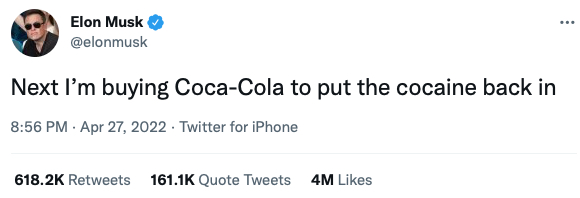
Elon Musk (apparently) buys "the de-facto public square"

 
Of course, my first response on Twitter was:


Yeah, but not seein' "the End of Western Civilization As We Know it" here.

I must have been out sick the day in grad school ConLaw when they covered "de-facto Public Square" (I cannot locate the words in the Constitution). 
 
Whatever, y'all. Have at it.

BTW: for a serious read on the history of "free speech,"

If Dirck Coornhert, Baruch Spinoza, John Lilburne, Olympe de Gouges, or Frederick Douglass were alive today they would surely declare the twenty-first century an unprecedented Golden Age for free speech. They would marvel at what can be freely discussed openly in real time between people across the globe with no looming Inquisition, Star Chamber, or Committee of Public Safety. No one in the Netherlands bats an eyelid if the doctrines of the Reformed Church are questioned or rejected. Every “free-born Englishman”—regardless of class or religious belief—has a right to criticize the government with no prior censorship or onerous laws against seditious words. In France, women have the same right to “mount the tribune” as men, and political heretics don’t have to fear the guillotine. And in the US, though racism is yet to be defeated, African Americans are no longer “dumb in their chains,” nor can they be silenced by repressive “black codes” or violent mobs acting with impunity.

Given the epic struggles, setbacks, false starts, and enormous sacrifices that led to this happy state of affairs, there is indeed much to celebrate about the current condition of free expression. But the Golden Age of free speech is in decline rather than ascendancy despite the unprecedented ubiquity of speech and information.

In the ninth century CE, Ibn al-Rāwandī could reject prophecy and central doctrines of Islam without serious punishment. But if he were alive today, his life and liberty would be severely threatened in a number of Muslim-majority countries, where blasphemy and apostasy are punishable by death. Even in secular democracies like France and the UK, al-Rāwandī’s radical ideas might well be met with the Jihadist’s Veto.

Gandhi would surely lament that India still uses colonial-era speech crimes to curtail the freedoms of speech and assembly that Gandhi considered the “two lungs that are absolutely necessary for a man to breathe the oxygen of liberty.”

Four decades ago, Western democracies relied on freedom of expression to empower dissidents behind the Iron Curtain, which contributed to the triumph of the Helsinki effect and the end of European communism. Today, the combination of free speech and technology ensuring the free flow of information across borders is increasingly seen as a trojan horse threatening democracy rather than a battering ram knocking down the walls of censorship in closed societies.

At times European democratic leaders have sounded more like a distorted echo of the Soviet apparatchiks who warned against the flood of Western “racism,” “fascism,” and “false propaganda” than the stewards of democracies built upon the central premise of free and open debate for all. Eleanor Roosevelt’s prescient warning that prohibiting incitement to hatred under international human rights law “would encourage governments to punish all criticism under the guise of protecting against religious or national hostility” has been forgotten.

In the US, the robust legal protection afforded by the First Amendment can barely disguise that the underlying assumptions of American “free speech exceptionalism” have lost much of their unifying appeal. As an abstract principle, American faith in free speech remains strong. But the unity collapses along unforgiving tribalist and identarian lines once each side’s sacred taboos are violated by the other side…


Mchangama, Jacob. Free Speech (pp. 383-385). Basic Books. Kindle Edition
Excellent book.
 
Maybe Musk will make Twitter less toxic, net. Maybe not. Will he make it profitable? I guess we'll see (, moreover, he didn't cut a personal check; this whole deal is leveraged out the wazoo with Other People's Money, collateralized with stock from his other ventures so I have to question the extent of his unilateral whimsical authority).
 
I mostly have just used Twitter to pimp my blog (it seems to have worked pretty well), and my days are waning in any event, so I could certainly live without social media broadly. And, were Musk to order Donald Trump et al reinstated to Twitter, that might be the day I delete.

NEWS UPDATE
A sharp fall in Tesla’s share price is raising doubts that CEO Elon Musk will be able to go ahead with his $44 billion purchase of Twitter. Tesla fell by 12.2 percent on Tuesday, slashing $126 billion off the market value of the electric automaker. That drop cut the value of Musk’s Tesla stake by $21 billion, which, as Reuters noted, was exactly the same amount he has committed in equity to the Twitter buyout. One analyst said the possibility of Musk selling shares, and becoming distracted by the bid, was causing “a bear festival on the [Tesla] name.” Others said continued falls in Tesla’s share price could jeopardize his funding arrangements. On a bad day for tech stocks, Twitter shares also fell back to trade around 8 percent below Musk’s offer price of $54.20 a share—reflecting fears that the world’s richest man might walk away from the deal. —Daily Beast
Interesting.

Where does all of this leave Trump's poignant "Truth Social?"
 
UPDATE
 

Right. Richest dude on earth, gaslighting away in juvie fashion. Seriously?
________
 

Sunday, April 24, 2022

Two months of Hell in Ukraine

Photo by Nicole Tung, Kharkiv
What a terrible waste. No clear end in sight as yet.
 
UPDATE: A TAD OF GOOD NEWS

Le Pen supports Vladimir Putin, and would have wreaked havoc in NATO.
__________
 

Friday, April 22, 2022

The so-called "science of deliberation."

An update.


Three years ago AAAS published an article entitled "The crisis of democracy and the science of deliberation." 

The "crisis" continues. As to "deliberation science," my dubiety remains. Google search the phrase and the top results remain the 2019 AAAS article.

apropos, read an interesting essay in my new Harper's Magazine today.
Modern democracies are facing a deep cognitive crisis. For many years now, societies have been living with moral relativism, which asserts the essential subjectivity of all value systems. Liberalism was founded on the premise that people disagree on the final ends of life or understandings of the good. Postmodernism, however, has moved us further, from moral to cognitive relativism, in which even factual observation is regarded as subjective.

The journalist Jonathan Rauch notes that the approach to factual truth coming out of the liberal Enlightenment rests on trust in a social system that adheres to two rules: that no one gets the final say, and that knowledge must be based on empirical evidence and not on the authority of the speaker. To this we need to add a battery of techniques that seek to either verify empirical propositions through inductive reasoning or falsify them through observation. These techniques are known collectively as the scientific method, and its rise was critical to liberalism’s struggle against religion. Science was able to defeat it because it could produce repeatable results. The manipulation of nature produced the modern economic world, where continuous growth through technological advance could be taken for granted. Scientific approaches to health led to huge increases in longevity, and military technology conferred huge advantages on states that could be used to defend or conquer. Science, in other words, became strongly associated with power, perhaps exemplified by the mushroom cloud exploding over Hiroshima in August 1945.

Precisely because modern science was so intimately associated with existing power structures, it engendered a prolonged critique that questioned whether its dominance was justified. In a series of brilliant books, Michel Foucault argued that the language of modern science was used to mask the exercise of power. The definitions of mental illness, the use of incarceration to punish certain behaviors, and the medical categorizations of sexual deviancy were not based on neutral empirical observation of reality, but rather they concealed the operation of broader power structures that subordinated and controlled different classes of people. The supposedly objective language of science encoded these interests in ways that hid the influence of power holders; people were thereby unconsciously manipulated into affirming the dominance of certain ideas and the groups that stood behind them.

With Foucault, deconstructionism evolved into postmodernism, a more general critique of the cognitive modes that had been strongly associated with classical liberalism for centuries. This critique was easily incorporated into the varieties of critical theory that proliferated in the United States from the Eighties onward, and were used to attack the racial and gendered power structures of the time.

At the heart of the liberal project lies the assumption that if you strip away the customs and accumulated cultural baggage that each of us carries, you’ll find an underlying moral core that we all share and can recognize in one another. It is this mutual recognition that makes democratic deliberation. But this idea has come under attack with the growing awareness of identity’s complexities. Individuals are not the autonomous agents of liberal theory; they are shaped by broader social forces over which they have no control. Knowing is not an abstract cognitive act, but is intimately bound up with doing, acting, and being acted on. It is impossible to reject many of these ideas, because they begin from observations that are indubitably true.

The whole enterprise of neoclassical economics has presented itself as a neutral application of the scientific method to the study of economics. Among social scientists, economists have gone the farthest in trying to formalize their theories with abstract mathematical models, and in developing a rigorous empirical methodology to validate them with. But this did not prevent them from falling prey to the attractions of power and money. Deregulation, privatization, and a strict defense of property rights were pushed by wealthy corporations and individuals, who created think tanks and hired big-name economists to write academic papers justifying policies that were in their private interests.

Many criticisms of modern natural science and the cognitive approaches associated with classical liberalism were therefore justified. But some critical theorists went beyond attacks on specific misapplications of the scientific method, to a broader critique of science as it had evolved since the Enlightenment. They argued that the search for human universals fundamental to liberalism was simply an exercise in power, one that sought to impose the ideas of a single civilization on the rest of the world…

—Mistaking Identity. by Francis Fukuyama
"At the heart of the liberal project lies the assumption that if you strip away the customs and accumulated cultural baggage that each of us carries, you’ll find an underlying moral core that we all share and can recognize in one another. It is this mutual recognition that makes democratic deliberation."
 
U.S. Democracy appears to be at significant, increasing risk of late.
 
Erratum:
“Experts need to remember, always, that they are the servants and not the masters of a democratic society and a republican government. If citizens, however, are to be the masters, they must equip themselves not just with education, but with the kind of civic virtue that keeps them involved in the running of their own country.” —Tom Nichols
Bummer headline:
 
Interesting thoughts by Russ Greene over on Medium: "John Gray in a friendly semi-debate with Francis Fukuyama. To be sure, asking John Gray whether liberalism is in trouble is much like asking a chiropractor whether you need an adjustment..."
Liberalism’s Saving Grace: It Falls Short

...The antiliberals are right to claim that liberalism falls short as a source of meaning, and an ethical system. Antiliberals are wrong, though, to insist that this fact discredits liberal government, or somehow justifies an illiberal rejection of constitutionally limited, liberal democracy. After all, liberalism is rooted in, and fosters, enduring institutions of morality and meaning that help lift our eyes above our own greed and pride…

A liberalism rooted in the insights of both David Hume and Paul of Tarsus, reason and revelation, is needed to meet the challenges of our present moment. Such liberalism may be necessary to defend the “self-evident” truths Thomas Jefferson articulated in the Declaration of Independence, the same ones that Frederick Douglass called “saving principles.”

Call it conservative liberalism. Or, perhaps, American liberalism.
Good writer. Clear thinker. Just got onto him today.

OK, ONE MORE THING

__________
 

Wednesday, April 20, 2022

U.S. Naval War College Russia expert Dr. Tom Nichols

…I have spent my life trying to understand Russia and its people. Now, like everyone, I am disgusted by Russian savagery. Fury grows in me each time I see the mutilated corpses and leveled homes—not only because of the sadistic violence, but also because I know that the Russian regime, in trying to destroy the Ukrainian nation, has destroyed a chance, at least for some years to come, for a better world.

And for what?

For the messianic dreams of a small man, a frightened and delusional thug leading a criminal enterprise masquerading as a government, who believes that he is doing God’s will.

You might be surprised at the last sentence, but Vladimir Putin really believes this. He thinks he’s on a mission. I’ll come back to this in a moment, but it’s a reality that too many in the West have either overlooked or chosen to ignore. And as much as I’d like to lay all of this mayhem on Putin’s shoulders alone, we now have to accept that his butchery of innocent people is either tacitly or openly supported by millions of Russians. Yes, there are brave Russians who have risked their lives to protest this war, but there is no way, any longer, to deny that Putin enjoys more support than any decent nation should give to such horror.

And so I grieve not only for Ukraine, but for the knowledge that no matter how this war ends, the era of hope that began in 1989 is over. Ukraine is now the scene of the largest conflict in Europe since World War II. NATO and Russia are openly enemies again. Nuclear war, for a time a forgotten abstraction, is a real danger…
@RadioFreeTom on Twitter. Excepted from The Atlantic, Putin's Holy War (probably paywalled). A compelling, disturbing read. Putin is a seriously Bad Actor.
 
 
Getting close to two months of daily morning just-outa-bed doomscrolling—"well, OK, President Zelenskyy is still alive..." More than 5 million Ukrainians are reported to have now fled their country. It is all very depressing. 

UPDATE:
TRYING TO RE-FOCUS ON SOME OTHER EXIGENCIES

Two books just reviewed in Science Magazine:

While most people understand that we face a looming climate disaster characterized by severe droughts, melting glaciers, and increasingly common wildfires and superstorms, certain technical details, policy considerations, and related justice and equity issues remain murky. Two timely new books aim to fill these gaps in knowledge.

In Is Science Enough? Forty Critical Questions About Climate Justice, historian Aviva Chomsky breaks down the key concepts, terminology, and often-contentious debates that surround climate change so that audiences ranging from students to activists can easily understand them. As the title implies, Chomsky argues that scientific interventions are not sufficient to combat global warming. Our current economic paradigm, she argues, relies on “extracting and consuming the earth’s resources in ever-increasing quantities, and turning them into waste,” and such a system is incompatible with a healthy planet…

In What Climate Justice Means and Why We Should Care, moral philosopher Elizabeth Cripps argues that we all share a responsibility to combat the effects of a changing climate that is disproportionately affecting those who have done the least to cause it. She presents clear and compelling evidence of the burden borne by disadvantaged populations, maintaining that climate change is, above all, “about privilege.”

Ten countries, Cripps notes, are responsible for 60% of greenhouse gas emissions—a major driver of climate change—and while the impacts of climate change are global and include severe winter storms in Texas, wildfires in Australia, and floods in Europe, the Global South has suffered the most devastating consequences. Between 2008 and 2016, she writes, roughly 22 million people were displaced in the Global South each year. The consequences of such displacements include child marriages, loss of schooling and employment opportunities, food insecurity, and more…
Just starting these. Stay tuned. apropos of my episodic Anthropocene riffs, albeit principally from the ethical points of view.
__________


Monday, April 18, 2022

Jacob Collier, the antidote for our current world miseries

 
Jacob Collier is an astonishing young musical genius from the UK. He is the antithesis of Vladimir Putin. (BTW, the older violinist, on the right at 6 seconds in is his Mom.)
 
His eclectic, voluminous work thus far is magnificent. His humanity equally so.
 

__________


Wednesday, April 13, 2022

Citizen K

Post-Soviet history and the path toward genocide in Ukraine.
Oscar-winning writer/director Alex Gibney’s revelatory CITIZEN K is an intimate yet sweeping look at post-Soviet Russia from the perspective of the enigmatic Mikhail Khodorkovsky, a former oligarch turned political dissident. Benefitting from the chaos that ensued after the dissolution of the U.S.S.R., Khodorkovsky was able to amass a fortune in financing and oil production and became the richest man in Russia. But when he accused the new Putin regime of corruption, Khodorkovsky was arrested, his assets were seized and following a series of show trials, he was sentenced to more than ten-years in prison. Today, as an exile living in London, he continues to speak out against Putin’s two-decade stranglehold on power. Expertly researched and photographed, Gibney uses Khodorkovsky’s story as a way to explore the complex interplay between oligarchy and government and its destructive effect on democracy, in Russia and beyond.
Two hours and six minutes of excellence. I watched it all yesterday (on Amazon Prime). Highly recommended. Puts today's Russian military atrocity in stark perspective.
 
UPDATE
 
 
Russia's Black Sea naval flagship, the missile cruiser Moskva, was hit by two Ukrainian-made Neptune missiles yesterday (Apr 14th), and then sank while being towed back to Sevastopol in heavy seas. U.S. Pentagon now confirms this report. Wow. Hostilities may soon ramp up materially in retaliation.

So, here we are at nearly two months in. I have to admit that, like many, I feared that Ukraine would be overrun in days, with President Zelenskyy killed or captured. I also expected that there would be major cyber-espionage outages, perhaps aimed at power grids and the financial system (and the internet more broadly). I no longer have any outcomes expectations.

The anxious daily doomscroll continues...
__________
 

Sunday, April 10, 2022

Will we soon forget about Ukraine? We must NOT.

George Packer certainly echoes my concerns.

In this country, Ukraine has done what nothing else—no election or insurrection, no pandemic, no environmental catastrophe—could do: shown the difference between right and wrong, heroism and barbarism, truth and lies, with such clarity that most Americans are in agreement…

Yet I worry that we’ll soon forget about Ukraine. It’s far away, and Americans have famously short attention spans.


In the days after Zelensky’s speech to Congress, you could sense American life returning to its natural state. Republican senators accused Judge Ketanji Brown Jackson of being soft on pedophilia, then checked their phones for their mentions. Meta Platforms announced that CEO Mark Zuckerberg will spend more time working remotely from his 1,500-acre Hawaiian estate and other homes. Kylie Jenner told her 325 million Instagram followers that her newborn son will no longer go by the name of Wolf. An online horde of journalists attacked The New York Times for publishing an editorial in defense of free speech. For 72 hours, Will Smith slapping Chris Rock at the Oscars was bigger than the war in Ukraine. The endless self-regard, triviality, and cynicism of American culture in the age of digital polarization seeped back, amid images of Ukrainians filling sandbags on the Odesa beaches or risking Russian shelling to bring shelter dogs to safety.

Even when the cause is just, people inevitably lose interest in far-off calamities that happen to people they don’t know. Against the will, a numb indifference sets in, and life goes relentlessly on…

Can the war change anything in this country? Ukrainians, in their struggle to build a democracy out of an autocratic past, have looked to the American example. What will it take for us to be worthy of them?

The questions aren’t idle. Ukraine’s survival requires the sustained support of its most important ally, the United States. Time will not be on Ukraine’s side. If the war drags on for months, it will grow murkier to Americans watching at a distance; its moral clarity will start to blur. Ukrainians’ justifiable rage at all things Russian will produce images that foreigners will find less easy to love than the picture of a string quintet performing in the ruins of a Kharkiv metro station. We’ll see more reports of Ukrainian atrocities that are not the inventions of the Kremlin, Fox News, or Glenn Greenwald. Some Americans will conclude that distinguishing propaganda from truth isn’t worth the effort, that it’s all the same (which is the goal of Russian propaganda). They’ll start to wonder why they have to pay $5 or $6 a gallon for gas with no relief in sight. Going into the midterms, Republicans will be happy to highlight these troubles and hang them around the neck of the party in power.

So the fate of Ukrainian democracy depends in part on American staying power. And in turn, the health of American democracy depends in part on Ukraine. If Vladimir Putin succeeds in demolishing Ukraine, converting its fragments into the vassal states of a new Russian empire, then strongmen and wannabes around the world will be emboldened. Putin will have won his bet that what matters in global affairs is raw power, that oil and gas are more important to Europe than freedom and justice, that the West is too tired and comfortable to sacrifice for its supposed values—that, as he said last summer, “the liberal idea has become obsolete.”

If, on the other hand, Putin’s regime of militarized kleptocracy—fascism without the inspiration—suffers an unmistakable defeat, it will diminish American authoritarians of all types. Ukraine’s win might start to clear out some of the reflexive cynicism that corrodes our politics. The current position of most Republicans—denouncing Russia and criticizing Biden for not doing more to help Ukraine, yet saying nothing when Trump calls Putin a “genius” or openly asks him for political favors while Russia commits war crimes—will become less tenable. Russian aggression will be harder to explain away than American insurrection, and Putin will be harder to defend than Trump. Republican anti-Trump voices will gain numbers and strength. The party will have to decide whether it wants to enter the 2024 elections still infected with the homegrown strain of an utterly discredited Putinism. That can’t be opposed abroad while it’s being stoked at home.

To win, Ukraine needs the stakes of the war to be clear to Americans. If the conflict comes to be seen as an impenetrable European mess, a war over spheres of influence and natural gas, or proof of the West’s hypocrisy, the American public will stop caring…

…Americans cannot afford to forget about Ukraine. When Zelenskyy says that Ukraine is fighting for us and our values too, we had better believe him. Liberal values don’t revive spontaneously or vicariously. They have to be defended, practiced, empowered, and criticized. The weeks since February 24 recall the period after September 11—the sense of crisis and unity at a historic turning point—but there’s this difference: Two decades ago, at the height of the unipolar era, America was blind with hubris. The sense of unity soon took the form of a fearful triumphalism. The Bush administration’s National Security Strategy of 2002 declared: “The great struggles of the twentieth century between liberty and totalitarianism ended with a decisive victory for the forces of freedom—and a single sustainable model for national success: freedom, democracy, and free enterprise.” America, the paragon of this model, would lead the world—with us or against us—in a new struggle for liberty.

Twenty years later, with the failures of Iraq, Afghanistan, and the War on Terror, with the rise of new powers abroad, with rampant economic inequality and entrenched political hatred at home, the 9/11 fever is gone. We suffer from its opposite: exhaustion, disbelief. Ukrainians are right to worry that we’ll soon lose interest and lapse back into our solipsistic dysfunction…

I have to agree. Read all of it at The Atlantic.


RE-POSTING ANNE APPLEBAUM
THERE IS NO LIBERAL WORLD ORDER
Unless democracies defend themselves, the forces of autocracy will destroy them.

By Anne Applebaum

There is no natural liberal world order, and there are no rules without someone to enforce them. unless democracies defend themselves together, the forces of autocracy will destroy them. i am using the word forces, in the plural, deliberately. many american politicians would understandably prefer to focus on the long-term competition with china. but as long as russia is ruled by putin, then russia is at war with us too. so are belarus, north korea, venezuela, iran, nicaragua, hungary, and potentially many others. we might not want to compete with them, or even care very much about them. but they care about us. they understand that the language of democracy, anti-corruption, and justice is dangerous to their form of autocratic power—and they know that that language originates in the democratic world, our world.

this fight is not theoretical. it requires armies, strategies, weapons, and long-term plans. it requires much closer allied cooperation, not only in europe but in the pacific, africa, and latin america. NATO can no longer operate as if it might someday be required to defend itself; it needs to start operating as it did during the cold war, on the assumption that an invasion could happen at any time. Germany’s decision to raise defense spending by 100 billion euros is a good start; so is Denmark’s declaration that it too will boost defense spending. but deeper military and intelligence coordination might require new institutions—perhaps a voluntary European legion, connected to the European union, or a Baltic alliance that includes Sweden and Finland—and different thinking about where and how we invest in European and Pacific defense.

if we don’t have any means to deliver our messages to the autocratic world, then no one will hear them. much as we assembled the department of homeland security out of disparate agencies after 9/11, we now need to pull together the disparate parts of the u.s. government that think about communication, not to do propaganda but to reach more people around the world with better information and to stop autocracies from distorting that knowledge. why haven’t we built a russian-language television station to compete with putin’s propaganda? why can’t we produce more programming in Mandarin—or Uyghur? our foreign-language broadcasters—radio free europe/radio liberty, radio free Asia, radio martí in Cuba—need not only money for programming but a major investment in research. we know very little about Russian audiences—what they read, what they might be eager to learn… 
As soon as the CBS 60 Minutes interview with President Zelenskyy is posted to YouTube, I will put it up. I have it on TV right now. I couldn't give a flying flip about who won the NCAA hoops final or the Master's Golf Tournament in the face of all this misery.
 
Been stewing over the "Crisis of Democracy" for quite a while now. 

 
Corruption, kleptocracy are significant factors.


UPDATE


More shortly...
__________