NOW POSTING FROM BALTIMORE. A private, non-commercial blog begun in support of the federal Meaningful Use REC initiative, and Health IT and Heathcare improvement more broadly. Now focused on important broader STEM and societal/ethics topics. Formerly known as "The REC Blog."
NOTE: Comments are moderated, thanks to trolls and bots.
That (surprisingly?) took just a mere few hours (~5). Next? Remanded to remain in MCC pending sentencing (in March 2024)? Hey, I know! We'll let your jive ass out on bail to go do some on-the-ground Effective Altruism interim humanitarian work in Gaza. The Bayesian Priors are maxed-out up front (in myriad 30-ft deep bomb craters), the Expected Value dwarfs any of the speculative virtue-signaling bullshit you, your brother, your Dad, and Mother spewed ad nauseum).
CODA
Enough of this guy. Save one final worthy citation.
Over the course of the trial, the jurors were largely spared an extended discussion of the doctrines of effective altruism, although Ellison did mention at one point that Bankman-Fried’s pure utilitarianism left him unbothered by the ethical strictures—don’t lie, don’t steal—with which ordinary people are saddled. For what it’s worth, most effective altruists express a belief in utilitarianism “with side constraints”—that is, their aspirations to do the greatest good for the greatest number tend to be leavened with the normie morality of at least the major Commandments, if not all ten. Effective altruism was, however, present in style if not in substance. Even the most winning E.A.s—a group that includes Nishad Singh, someone I personally liked very much when I interviewed him eighteen months ago—are the most pedantic people alive. They believe they speak the mathematically precise language of the knowable universe. When Singh took the stand and banged on about things like auto-deleveraging events and liquidity backstop providers, the judge, his patience with E.A. specificity wearing thin, cut him off: “You stick to answering the questions that are asked, O.K.?”
"Effective Altruism," as widely espoused these days in neoliberal / libertarian ECON circles, is a self-serving perversion of the utilitarian moral philosophy that first gained global traction via the works of Australian activist academic Peter Singer.
The original elevator speech went something like this: "in a world where needs will inexorably exceed available resources, we have a moral imperative to direct our charitable resources to the "highest & best" / "most effective" use.
Bang for the buck, essentially.
The roughly 10 Grand I've plowed into my veterinary frequent-flier Ranger, my 2018 California 90 lb Chocolate Lab mix stray rescue, is ostensibly "morally" wanting in such regard, given the massive intractable human miseries around the globe.
Whatever. Ranger stays. As do our monthly contributions to the MD Food Bank and a number of other worthy causes. I have no need of self-appointed moral critics evaluating the extent and "effectiveness" of my relative beneficence.
In light of my Master's in applied ethics ("Ethics & Policy Studies"), I found it intriguing, and thought I ought give EA a close, charitable read. Alluring in gauzy, vague principle, nonetheless it raised more questions than answers.
“EFFECTIVE ALTRUISM" CIRCA 2022
Nowadays it's fashionable in rapacious digerati circles to wield "effective altruism" as impenetrable Virtue Signaling armor—akin in a way to "Prosperity Gospel."
"Think about how much good you could do if you were a young, adroit, fearless crypto billionaire."
Which brings us back around tot this shitstorm.
More to come. This kid's parents are both Stanford Law professors (Joseph & Barbara). The 28 yr old Caroline Ellison he chose to be CEO of his wholly-owned Alameda Research (uh, hel-LO?) is the daughter of two vaunted MIT Economics professors (Glenn & Sara).
Prestige institutions, the Best-and-Brightest offspring. Depressing.
…The unwind of FTX is certain to dominate business press, pundit, and politician attention due to how its uber connected and very recently idolized top brass have been revealed as drug-addled business incompetents who neverless seem to have done a very good job at disappearing a lot of the moolah, presumable for their personal use. The level of media noise and coming prosecutions (both the Southern District of New York and Bahama are reportedly ginning up filing) and the failure of supposedly sophisticated player to find anything amiss will presumably chill interest in crypto, particularly if other firms fall over due to FTX contagion…
In the beginning, there was Satoshi Nakamoto, the pseudonymous programmer who created Bitcoin and promised an entire new way of thinking about money—and, by extension, power and politics. But, after it became clear that Nakamoto wasn’t going to appear on some mount and pass his tablets down to the masses, the cryptocurrency world began to yearn for a proper evangelist. The people who have tried to fill that role have mostly been self-appointed, such as Roger Ver, the loud and impassioned former C.E.O. of Bitcoin.com, and the man behind Bitcoin Cash; Vitalik Buterin, the enigmatic and perpetually bemused creator of Ethereum; and the Winklevoss twins, the Facebook-involved duo immortalized in the film “The Social Network,” who started the Gemini exchange and pushed for years for a Bitcoin exchange-traded fund, which they argued would spread the gospel to every brokerage account in America. The reason that the crypto community felt like it needed someone in this role was relatively simple: Internet money requires a leap of faith in a new society. What that particular new world might look like has always been a bit vague, with a few nods to the Austrian School of Economics, or seamless economies that are run entirely on smart contracts. But the pitch to you, the consumer, has always remained the same: In the crypto future, whatever it is, you will be incredibly rich…
Sam Bankman-Fried, the disgraced founder of the cryptocurrency exchange FTX—which went bankrupt this month in one of the most spectacular financial implosions since the Bernie Madoff scandal—was the latest and the most effective crypto messiah, precisely because he did not really seem to take crypto all that seriously. His creation myth has it that, after a very credentialled early life in which he, the son of two Stanford law professors, excelled in his private school, went to M.I.T., and then went off to go work on Wall Street, Bankman-Fried became enamored with effective altruism (E.A.), a somewhat scattered philanthropic philosophy that tries to optimize the good that can be done through charity, but whose members also spend an unusual amount of time worrying about the threats of sentient artificial intelligence. Bankman-Fried decided that he would try to make as much money as he could, in order to give it away in an E.A.-optimized way. He claims that he didn’t know what a blockchain was when he got started in crypto, which, he also said, was a field made up of projects that were mostly “bullshit.” But it also was a means to an end. The world would be better if he, the smartest guy in the room, had more money to distribute, and crypto was the fastest way to get rich. All it took, it turns out, was a series of massively leveraged bets, some hilariously creative bookkeeping, and an abiding belief that the trust in his credentials and in his philanthropic vision would keep people from even peeking under the hood…
For anyone checking out “the team,” the entire mix of Bankman-Fried’s appeal can be found here: the litany of prestigious universities, the association with serious thinkers, and the belief in a philosophy that doesn’t set off any ideological alarms. Among the people who wanted to turn Bankman-Fried into an A.T.M., the details added up to the story of a new type of smart guy who believed all the same things they did about crypto, and who was going to change the world.
If that narrative sounds familiar, it’s because it’s become the standard bildungsroman in journalism covering business, tech, and, in some ways, sports. It’s how many journalists talked about Mark Zuckerberg and Paul DePodesta, the Harvard graduate who convinced Billy Beane, the general manager of the Oakland A’s to build his team around analytics and “Moneyball.” In these stories, some young person who went to Harvard is always outsmarting the dumb establishment, the members of which all went to Harvard, too. The addendum is that the world will somehow be a better place if they win…
AT THE ATLANTIC
My Crypto Confession Sam Bankman-Fried was a member of two cults: one I have criticized, and one I belong to. By Derek Thompson
Sam Bankman-Fried, the disgraced founder of the trading platform FTX, was a member of two cults. Or, more precisely, he was a figurehead of two movements that outsiders considered cultish. One of these movements I have criticized relentlessly. The other I belong to.
The first is the cult of crypto. I’ve made little secret of the fact that, although I think crypto is anthropologically fascinating, its substance, so far, is almost completely lacking. The blockchain and its related innovations are sometimes described as extraordinary technology in search of an ordinary use case. They are also a glossary in search of a spine—pages worth of lingo (gm, ngmi, maxis, DeFi) that are, as of now, unglued from any stable vision of the future besides the bet that certain asset values will go up. To reinvent the casino and tell yourself that, next up, you’ll reinvent the world, requires either the mind of a time-traveling genius or the faith of a simple zealot…
ARE YOU SHITTING ME?
Sam and Caroline, Titans of DigiFi.
I have every confidence that there is much more skeevy stuff to come.
AGAIN: Old School here doesn’t know much about crypto etc per se but my profitable 2000-2005 tenure in subprime risk management left me with a material thought or two. Technologies may change, but the lure of the grift does not.
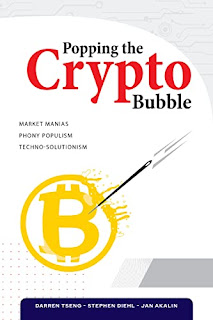
“Cryptocurrency is a giant scam, although a complicated scam . . . ” So begins Stephen Diehl’s diatribe against the crypto industry. When he published it in June, Bitcoin and other crypto assets were trembling. Since then, the collapse of FTX, the second-largest crypto exchange, has created a potentially existential crisis. Billions of dollars of customer assets seem to have been incinerated, along with FTX founder Sam Bankman-Fried’s status as an altruistic visionary. Is crypto all just a mirage?
Like Bankman-Fried, Diehl is a thirtysomething American with a nerdy manner and unbrushed hair. But while Bankman-Fried urged US lawmakers to carve favourable new regulations for crypto, Diehl pulled the other end of the rope. He lobbied for crypto to be regulated like other assets. In June he co-ordinated a letter of 1,500 technologists to senior members of the US Congress, urging them to look past “the hype and bluster of the crypto industry” and understand its “inherent flaws”.
Diehl has the grasp of programming and economics to question crypto from first principles. He has tried to sell blockchain technology — the distributed databases on which crypto is built — and believes that he could have ridden the crypto wave: “Anybody who looks like a nerd like me can probably go to the Valley and raise $50mn from some very credulous [venture capitalists] to pump a token and make a life-changing amount of money.” Instead he stood on the sidelines, blogging about crypto’s failings. That won him a following — but also harassment, including death threats. “The past three years have been hell,” he says, naturally shy. “It’s not easy being a crypto sceptic.”
Diehl’s book, Popping the Crypto Bubble, traces Bitcoin’s emergence during the global financial crisis to the post-2016 crypto gold rush, which he refers to as the “Grifter Era”. He argues that crypto is slow (it relies on broadcasting transactions across decentralised networks) and unreliable (individuals are responsible for securing their assets; when they lose passwords or die, there is much less recourse than with, say, a bank). It cannot be both a great investment, which goes up and up, and a viable currency, which offers stable value. He argues that crypto assets’ price is based largely on there being an even greater fool who believes the hype.
“After 14 years, it is still a solution in search of a problem. It’s not building a new financial system. It’s not building a new internet. It’s not an asset uncorrelated with the market. It’s not a hedge against inflation. It is a vehicle for pure, naked speculation detached from anything in the economy. It’s a casino that’s wrapped in all of these lies. When you tear back those lies, what’s left looks like a net negative for the world.” You may not be interested in crypto, but you should be. “It reveals a lot of our dark tendencies,” Diehl says. “And it’s a mirror for a lot of the political struggle in society.” ...
UPDATE:
bought the book. An interesting read thus far. Squares with my broad
historical knowledge of pre-crypto economic bubbles and frauds, along
with my thus far relatively shallow (albeit accruing) education on this
new finance technology. UPDATE2: I'm about 80% through the book. Hugely informative and enjoyable read, highly recommended. This crypto crap has gotta be stopped. It's dangerous. UPDATE3: Finished it. Excellent.
That’s a rough approximation of the total value destruction across the cryptocurrency space from the peak seen in early November 2021 through Tuesday morning, when Bitcoin sat at a two-year low, and endorsement payments to Tom Brady from FTX were being scrutinized by Texas regulators.
Who could’ve known, just 12 months ago, that things would turn out this way for crypto? After all, the private money business sounded even more compelling this go-around than it has in the past.
I’m being sarcastic, of course. The private money business never works, and this time most assuredly wasn’t “different.”
In the wake of the FTX fiasco, much of the breathless crypto coverage emanating from the financial media (mainstream, alternative and otherwise), seems to intentionally avoid addressing the elephant in the room. If that’s the case, it’s understandable. Because to address it would be to concede that nearly everyone — from large media conglomerates to the most respected venture capitalists on the planet to storied hedge funds — was duped into believing that all it took to make the private money business viable was a single innovation.
That’s plainly absurd. For one thing, some experts offer trenchant arguments against the idea that blockchain constitutes a “technology” at all, if technology is supposed to be synonymous with true innovation. Even if it is an innovation, many skeptics argue it’s not an especially useful one. In the interest of brevity, I won’t walk through those arguments, but you can certainly do so yourself if you have Google and half an hour to spare.
Beyond that, though, the notion of private money at scale, and, more to the point, the notion of private money at scale as an investable proposition, is stupid. Not “misguided,” not “misplaced” and not any other more generous adjective either. Just plain old stupid…
"ALTRUISM," MY ASS
FTX Group corporate funds were used to purchase real-estate properties in the Bahamas, where the company had its headquarters, for employees and advisers. Reuters has reported that FTX, Bankman-Fried’s parents, and company executives bought a hundred and twenty one million dollars’ worth of real estate, mainly “luxury beachfront homes.” (FTX, Bankman-Fried, and the company executives did not respond to Reuters’ requests for comment. A spokesman for Bankman-Fried’s parents said that they had been trying to return the property to FTX before the bankruptcy proceedings. Separately, James Bromley, the FTX attorney, said on Tuesday that the company spent three hundred million dollars in the Bahamas buying homes and vacation properties for its senior staff.)
This is how Mr. Effective Altruist lived in the Bahamas. Notably absent were any rescued starving orphans from the Sudan or Syrian refugee camps.
In fairness, Mr. Bankman-Fried cannot begin to be His Most Awesomely Effective Philanthrophic Self until he achieves Trillionaire status (a notion he has mused about). Ya gotta do stuff At Scale these days. Hang in there, kiddies.
CODA
LOL. The irascible Randian contrarian take on "altruism."
Lordy, Mercy. She's also quoted as exhorting "Individualists of the world—UNITE!"
Whatever. So much fatuous incoherence, so little time... I think I need a drink.
Conservative political activist Ivan Raiklin claims to have assembled a “Deep State target list” that includes high-ranking Democrats and Republicans, U.S. Capitol Police officers, officials at the FBI and other intelligence agencies, witnesses in Trump’s impeachment trials, and journalists at The New York Times, CNN, The Washington Post, and other news outlets. Their supposed crime? Being Trump’s political enemies. And Raiklin views himself as justice incarnate.
During one podcast appearance earlier this year, Raiklin said his nickname was the “deep state marauder, a.k.a. the mauler.” Raiklin’s plan for what to do with his list isn’t nearly as gruesome, but it is still terrifying. He intends to enlist right-wing sheriffs to carry out mass arrests, and in May, he declared his intention to arrange “livestreamed swatting raids.”
Raiklin reportedly claims that if he went public with all of the so-called evidence he collected on Trump’s enemies in the deep state, it would be probable cause to arrest those high-ranking officials and journalists on his list.
Those arrests would be carried out by “constitutional sheriffs,” specifically a right-wing anti-government group called the Constitutional Sheriffs and Peace Officers Association. Those sheriffs would then deputize the 75,000 veterans Raiklin claims were dismissed from the military for refusing to comply with Covid-19 vaccine mandates, forming a rogue army intent on revenge…
Former Sheriff Richard Mack, who leads the Constitutional Sheriffs group, told Raw Story that he had severed ties with Raiklin in early June and did not approve of his rhetoric. “Quite frankly, he talks about that list of 350 people—I’m sure they can afford lawyers,” said Mack. “It reeks of lawsuits, and it doesn’t follow due process.”
Raiklin has also emailed sheriffs’ offices across the country hoping to enlist them to his cause. Not one has signed on, according to Raw Story.
Recall how Donald Trump has repeatedly promised his MAGA fans "retribution." This dude is a real piece of work.
GOP CONVENTION ERRATUM
I.Just.Can't.Do.Any.More...
I'd intended to stay up and her JD Vance's VP nomination speech. Decided it would be pointless.
In the wake of a sorry parade of MAGA D-list celebs—including Hulk Hogan, Dana White, Kid Rock, Tucker Carlson, Lee Greenwood—Donald Trump came out and babbled on for 93 minutes. Same litany. The less said about it the better.
One charming erratum: Son Eric Trump spoke to introduce his Dad, and claimed that his father "built the New York skyline."
Right. Sure.
Also, one musical performer was bumped from the final evening performance schedule after the Heiitage Foundation President learned of his religious beliefs.
Kid Rock was much more fitting.
BACK ON TASKS
I finished Frank Bruni's important book The Age of Grievance, and, in addition to several others still in play, I'm back onto the compelling book The AI Mirror.
If the image of AI as an imminent destroyer or supplanter of human dominance and supremacy were only a looking-glass fantasy—a flight of misplaced imagination, serving as a creative template adapted by generations of science fiction writers, then perhaps we could just enjoy it for its imagined possibilities. iRobot is a thrill! The Terminator is a lot of fun. The Matrix is a gas. Ex Machina is spellbinding. Westworld is mind-blowing (often literally—minds get blown open quite a lot)!
But in fact, the looking-glass illusion these entertaining fictions reflect is being leveraged today by billionaires, lobbyists, and powerful AI companies to directly influence and reshape public policy, scientific research priorities, venture capital investment, and philanthropic giving. It is being placed in service of movements to defer action on real and imminent existential threats—from climate change and ocean acidification to global pandemics and food insecurity—in favor of lavish funding for research on long-term AGI risk, which these powerful interests now claim outstrips all other dangers. The new tech-centered movement of longtermism, which grew out of an earlier movement called effective altruism, has put forth in many powerful academic, policy, and media circles the idea that AGI presents an incalculably greater threat than even climate change. Many longtermists now argue that the most prudent use of philanthropy and public resources for long-term human benefit is to invest more heavily in AGI risk and AI safety research. Yet it is not the safety of living humans today, or even the next generation, that drives longtermists.
Longtermist arguments often go as follows: because AGI in the far future could theoretically kill or immiserate even more living humans than are alive on the planet now, preventing future AGI from doing this is a more rational use of resources than funding clean energy tech, food security, or public health today. Related claims made by some longtermists include the idea that saving the future requires directing even more of today’s resources toward the wealthy in the Global North, rather than sending aid to the most impoverished countries in the Global South, since wealthy people in already disproportionately wealthy regions are better positioned to use their resources to fight these “existential” risks from AGI.
Longtermism is rooted in utilitarian ethics, a brand of moral theory that has long driven effective altruists to the contemporary work of philosopher Peter Singer. Utilitarianism, from its foundation in the nineteenth-century writings of philosophers Jeremy Bentham and John Stuart Mill to the AI-inflected writings of today’s longtermists, has always held that our first and highest moral duty is not to root out injustice, or cultivate virtue, or protect human rights and the planet, but rather to maximize the sum total of happiness that will be enjoyed in the future.
Peter Singer is widely admired for his vigorous defense of animal liberation on the grounds of their capacity to suffer, which subtracts from their happiness. He is less well known for his claims (still bitterly recalled by many disability activists) that it is ethical to kill so-called “defective infants” whose potential for future happiness he sees as severely compromised. What longtermists and effective altruists have in common with Singer is the utilitarian view that morality is a happiness optimization problem, a matter of running the numbers. Conveniently for AI enthusiasts, that makes morality just the sort of thing that computers and computer scientists are supposed to be good at!
For a virtue ethicist like me, there are profound dangers and moral errors in any view of morality that separates it from humane feeling, relational bonds, and social context, reducing it to a mere computation of net happiness units. As longtermist Eliezer Yudkowsky readily admits, this kind of fundamentalist utilitarianism licenses one to turn off moral feeling and just “shut up and multiply” happiness sums, even if the action dictated by the calculation feels deeply wrong or shocks the conscience. Some longtermists at Oxford’s Future of Humanity Institute (FHI) have used such license to entertain hypotheticals in which the welfare of billions of today’s suffering humans is dispassionately sacrificed for the potential to create far larger numbers of happy “digital people” in virtual worlds of the distant future. Others work out longtermist defenses of a related utilitarian view known as the Repugnant Conclusion: the proposal that given the option, it would be better to choose a world packed with people who all suffer so greatly that their lives are “barely worth living” than to choose a far more modest population of ten billion people who can all flourish.
These types of scenarios are often seen as compelling rebuttals to utilitarian logic. When taken instead as plausible moral obligations for humans, such scenarios are, as the philosopher and fierce critic of utilitarianism Bernard Williams famously said, the result of having “one thought too many.” Ideas like this did not dominate the early philanthropic thinking of effective altruists. From donating surplus personal wealth to the purchase of mosquito nets and other high-impact aid for the global poor, to investing in public health and climate resilience, much of what effective altruists initially tried to do is aligned with commonsense moral obligations to present and future generations. Even as the effective altruism movement merged with the more speculative AI fantasies of longtermism, many remained committed to fighting the existential threats already here: climate change, biohazards, and nuclear holocaust. As observed by a critic quoted in a 2022 profile on effective altruist and longtermist William MacAskill in The New Yorker, “If you read things that [effective altruists] are saying, they sound a lot crazier than what they’re actually doing.” If the more speculative AGI visions of longtermists were just intellectual side hustles for bored Oxford philosophers and Silicon Valley investors, we might think them harmless.
But today, longtermism is the language of moral thought spoken in a growing number of the wealthiest and most powerful political and industrial circles. Billionaires like Jaan Tallinn and Peter Thiel have been described as avid supporters, while Elon Musk, funder of the Future of Humanity Institute, has cited MacAskill as “a close match for my philosophy.” FHI Senior Research Fellow Toby Ord notes in his bio that he has advised “the World Health Organization, the World Bank, the World Economic Forum, the US National Intelligence Council, the UK Prime Minister’s Office, Cabinet Office, and Government Office for Science.” Ord was quoted to the UN General Assembly in a 2021 speech on climate by former British PM Boris Johnson. Nor do longtermists only seek influence in conservative political circles. FTX crypto founder and longtermist Sam Bankman-Fried was celebrated as a “megadonor” in US Democratic circles before being jailed on fraud charges, while longtermists in the UK formed a group called Labour for the Long Term to influence the Labour Party. Political influence is a core part of longtermist strategy. A 2022 position paper by Oxford’s Global Priorities Institute outlined their political case for institutional longtermism, the view that far-future considerations should dominate public policy and even our choice of political institutions, in contrast with longtermism as a personal philosophy for setting one’s own philanthropic priorities….
Vallor, Shannon. The AI Mirror: How to Reclaim Our Humanity in an Age of Machine Thinking (pp. 76-80). Oxford University Press. Kindle Edition.
"Longtermist arguments often go as follows: because AGI in the far future could theoretically kill or immiserate even more living humans than are alive on the planet now, preventing future AGI from doing this is a more rational use of resources than funding clean energy tech, food security, or public health today. Related claims made by some longtermists include the idea that saving the future requires directing even more of today’s resources toward the wealthy in the Global North, rather than sending aid to the most impoverished countries in the Global South, since wealthy people in already disproportionately wealthy regions are better positioned to use their resources to fight these “existential” risks from AGI."
A year ago, Sam Bankman-Fried (often called “SBF”) was on top of the world. He had been on the covers of Forbes, which dubbed him “the richest twentysomething in the world”, and Fortune – the equivalent, for a business leader, of a rock star on Rolling Stone, or an athlete on Sports Illustrated.
But in late 2022, his FTX crypto trading operation – and the closely related Alameda Research, an investment fund he had founded before FTX – both collapsed.
Bankman-Fried is currently charged with crimes relating to the disappearance of billions of dollars of FTX users’ money. These people did not think they were investing in FTX, or even lending to it. Their funds were just being kept there while they switched between, for example, dollars and bitcoins or between bitcoins and dogecoins. But instead it is claimed that their funds were transferred to Alameda and then lost.
Bankman-Fried is pleading not guilty and has published a statement reading: “I didn’t steal funds, and I certainly didn’t stash billions away.”
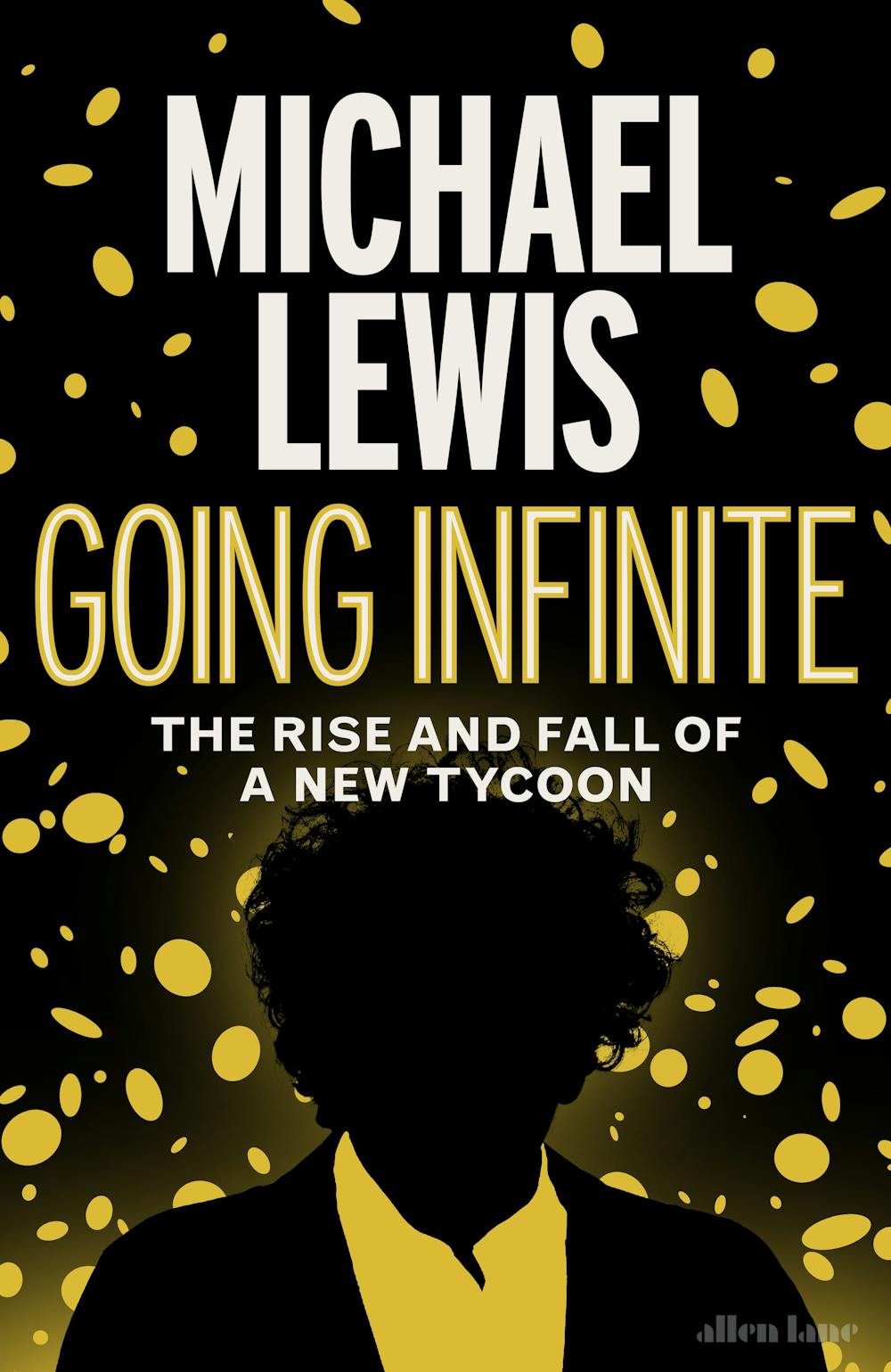
Review: Going Infinite: The Rise and Fall of a New Tycoon – Michael Lewis (Allen Lane)
Bankman-Fried, who was living in the Bahamas at the time of his arrest, now resides in a US prison. He is facing charges that could result in a sentence of more than a century behind bars and has been taunted as “Scam Bankrupt-Fraud”.
His remarkable story has been told by Michael Lewis, the author of Liar’s Poker, a Wall Street story drawing on his own experience as a bond salesman for Salomon Brothers; and the internationally successful book-then-film The Big Short, an account of the financial market shenanigans that led to the global financial crisis of 2007-09.
Lewis, who had extraordinary access to Bankman-Fried while writing, holds the unusual combination of degrees in art history from Princeton and economics from the London School of Economics. As a former bond salesman, he knows his way around financial markets and has seen his share of excess and oversized egos. As a journalist, he is skilled at clear writing about complex finance. He was ideally placed to write this book.
However, he has been widely criticised as too close to his subject. When Bankman-Fried was arrested, Lewis had been shadowing him for nearly a year. And as events unfolded – and even while Bankman-Fried was under house arrest – Lewis was there, taking notes.
Going Infinite derives its title from a question Lewis asked his subject: how much would he need to be paid to sell and walk away from FTX? Bankman-Fried initially replied: $150 billion. He then added he needed “infinite dollars” because he planned to address existential risks facing humanity.
Making the cover of Forbes is the equivalent, for a business leader, of a rock star on Rolling Stone.
This rather grandiose response was based on a concept called “effective altruism”, inspired by a 1971 essay by Australian philosopher Peter Singer.
Lewis’s example is that instead of becoming a doctor in Africa and helping some people, you can make a fortune and then pay for 40 doctors and help 40 times as many people.
Bankman-Fried claimed his motivation for FTX was to fund effective altruism. Some of his senior executives claimed to share this motivation.
Bankman-Fried felt Donald Trump was an impediment to actions that would make the world a better place. He donated to anti-Trump Republicans and to Democrats. One revelation in the book is that Bankman-Fried contemplated paying Trump not to run again for president. The figure mentioned was US$5 billion, but it is not clear whether this number came from Trump himself.
The odd life of Sam Bankman-Fried
Bankman-Fried’s parents are both Stanford professors. But there is no obvious factor in his childhood that explains his eccentricities, or why he seemed to have few friends.
Lewis writes that Bankman-Fried had to teach himself facial expressions, and that Bankman-Fried thought he had “an aching hole in my brain where happiness should be”. He skates over Bankman-Fried’s years as a high school nerd, where the place he most felt a kind of belonging was math camp, and as a MIT physics student. And he concludes that the future crypto king was perfectly positioned, emotionally and intellectually, to make a religion of himself.
One of the most interesting parts of the book is the account of Bankman-Fried’s early career at Jane Street Capital, a Wall Street high-frequency trading firm, where interns were encouraged to gamble with each other and with the full-time employees as a way of developing their professional skills. There, Bankman-Fried’s intuition about probability shone.
The “SBF” who emerges from the book has some similarities with the portrait of Elon Musk in the eponymous just-published biography by Walter Isaacson. Both men are convinced they are the smartest guy in any room they are in. And both have the hubris to think the future of humanity depends on them.
Bankman-Fried reportedly said there was a 5% chance he could become US president. The US constitution meant this was one takeover to which the South Africa-born Musk could not aspire.
Isaacson relates a half-hour telephone discussion between Bankman-Fried and Musk about the latter’s takeover bid for Twitter. After consulting colleagues for 15 minutes, with Lewis present, Bankman-Fried was considering contributing “maybe a billion” as part of a consortium being assembled by Musk. But the discussion did not go well. Both apparently thought the other was crazy.
This Forbes video purports to take readers behind the scenes of FTX in the Bahamas.
FTX was ‘essentially a casino’
So-called “cryptocurrencies”, like Bitcoin, are rarely used for their original stated purpose of making payments. They are really just speculative tokens with no fundamental value.
FTX promoted itself as the equivalent of a stock exchange for these cryptocurrencies.
Lewis writes:
The new crypto exchanges had no regulators. They acted as both exchange and custodian: they didn’t just enable you to buy bitcoin but also housed the bitcoin you’d bought.
FTX was no usual business operation. It was barely a business at all. FTX had no chief financial officer, nor even a list of its staff. It had a sort of board of directors, just for appearances. Bankman-Fried was one director, but in a conversation with Lewis, he could not recall the other two. As Lewis puts it, he “just thought grown-ups were pointless”.
Most of the senior staff at FTX and Alameda were friends of Bankman-Fried (although many have since turned on him, whether from a belated sense of shame or to try to wrangle shorter prison sentences). They lived and worked in a luxury compound in the Bahamas, a sunny place for shady people (as Somerset Maugham once described Monaco).
Apart from the luxury accommodation, there were other extravagances, such as food and chartered planes. Clothes were not one of them. Until his recent court appearances, Bankman-Fried was rarely seen in anything but a t-shirt and shorts - no matter the occasion.
One of his senior employees, Zane Tackett, told Lewis:
His oddness mixed with just how smart he was allowed you to wave away a lot of the concerns. The question of why just goes away.
FTX was essentially a casino. But Bankman-Fried both owned the casino and was gambling in it – apparently with other people’s chips. Alameda Research seemed to be making large bets with money transferred from the accounts of FTX customers.
While Alameda operated in the shadows, huge amounts were spent promoting FTX.
FTX spent tens of millions making an expensive advertisment featuring Larry David comparing crypto to the wheel, democracy and the moon landing. (It has already been screened at the trial.) At least, unlike Katy Perry, Larry can claim that in the advert he was sceptical!
The gag of this expensive ad for FTX, featuring a sceptical Larry David, is now reversed.
After FTX collapsed, John Ray, the bankruptcy expert tasked with sorting out the mess, remarked: “Never in my career have I seen such a complete failure of corporate controls and such a complete absence of trustworthy financial information.” And he had handled Enron!
Accused of having stolen billions
Somewhere between US$5 billion and US$10 billion of customers’ money from FTX seems to have disappeared. Lewis writes that it may have been lost in losing bets by Alameda. Lewis estimates that Bankman-Fried made over 300 separate investments - one every three days. There were certainly some poor investments, such as 101 Bored Ape NFTs, bought for US$24 million. These have lost about 90% of their value.
Bankman-Fried has been accused of having stolen “billions from thousands of people”. His lawyers responded that he is being painted as a “cartoon villian”. A lot will depend on whether the jury regards him as a calculating liar or an idiot savant “math nerd”, hopelessly out of his depth as a manager.
Another interesting aspect yet to emerge is how the top Wall Street and Silicon Valley investors explain their naivety in trusting Bankman-Fried. How do you explain what the Financial Times called the “legend of Sam”?
Michael Lewis has written ‘a letter to the jury’
Lewis seems inclined towards the view Bankman-Fried may not have been deliberately fraudulent. He has spoken of a “mob mentality” and a “very quick rush to judgement”.
Biographers seem to sometimes experience a literary equivalent of the now much-debated “Stockholm syndrome”. If they are embedded with their subject, they may come to share their world view.
Another recent book that profiles Bankman-Fried, Number Go Up by Zeke Faux, paints a similar picture in many ways – but is more sceptical about his motivations.
Faux makes the telling point that many of the punters lured in by the advertisements for FTX lost money they could not afford to lose. This is hardly the act of an altruist. Faux described Lewis as asking his subject questions “so fawning, they seemed inappropriate for a journalist” at an FTX-sponsored conference.
Like Lewis’s other books on financial shenanigans, Going Infinite does a good job of explaining complex financial concepts. And it is an entertaining read about an unusual and intriguing personality. But it does seem like it was rushed out to coincide with the trial. There is no index, for example. It will need a second edition once the current court case is resolved.
As Rebecca Coelius described it on The Health Care Blog, you “need to know what’s inside the box to think outside it.” Knowledge of clinical processes, including billing, compliance, and operations, is imperative for any startup that wants to intersect with health systems.
"Knowledge of clinical processes..." Yeah, and in that regard, you can't do any better than studying Dr. Jerome Carter's voluminous works at EHRscience.com.
Dr. Bradner-Jasik:
I left my role at UCSF because I was disappointed as companies with great ideas were passed over. I often sat through pitches thinking, This is terrific, but we will never buy this because …
The technology is great, but it doesn’t solve any pain point that we currently have.
The product does not integrate well with our clinical workflows, including our EHR.
The startup has an A+ solution to our problem, but our EHR has a C+ solution that we already paid for and can implement with little cost.
The technology budget has already been (over)spent on our EHR. Asking for additional resources is a heavy lift.
Our staff have tech fatigue from large, complex EHR rollouts. The bandwidth to train and implement another tech solution is not there.
Rock Health recently reported that digital health received $4.3 billion in funding this year. But at the same time, 75% of this went to early-stage Series A and B rounds for innovations that may not stick. To take us to the next phase, we need more cross-pollination of perspectives, among both startups and enterprise organizations alike. The seeds of this type of collaboration have already been planted, with innovation centers popping up at healthcare institutions, and startups hiring clinicians earlier...
So, what of Dr. Bradner-Jasik's startup, Mango Health?
"Mango Health helps you manage your medications and create healthy habits, so you can savor the moments that matter most."
From the L.A. Times:
“The Mango Health app reminds patients when it's time to take their medication and records each dose. It also automatically alerts users to potentially dangerous interactions between medications and supplements or with food and drink … But it’s the game component that sets the app apart.”
You might want to study the Privacy Policy. I wear a Fitbit HR my wife bought me. Their Privacy Policy is just as obtuse and vague and riddled with lawyerly weasel phrases.
The "game component" reference in the Times blurb caught my eye in particular. A little Morozov, anyone?
Yeah, I know, Evgeny's caustic riff can get a bit tiresome. Nonetheless...
___
Recapping,
Knowledge
of clinical processes, including billing, compliance, and operations,
is imperative for any startup that wants to intersect with health
systems.
I could not agree more. But, it's easy to gloss over the fact that inside effective "operations" lies the imperative of focusing on that which minimizes the cognitive burdens and maximizes the efficacy of clinician decision-making (sometimes referred to in part as Health IT "UX"). "Operations" goes well beyond conventional notions of "Process QI." I am reminded of my posts on "Lean Healthcare."
Directly apropos as well, a couple of my prior posts:
Electronic health record software manufacturers have taken early steps into application programming interface publishing, and savvy health informaticians have already created some clever mashups with them.
In late 2013, a study group of scientists released "A Robust Data Infrastructure," more commonly known as the JASON report, commissioned by ONC and AHRQ, which subsequently published the report in 2014.
(JASON is an initiative within the MITRE Corporation, a nonprofit that operates research and development centers sponsored by the federal government. JASON is spelled in all caps, but it is unclear what, if anything, it stands for.)
At any rate, the final rule for meaningful use stage 3, published in October 2015, can be found here (Google searches surprisingly don't rate this link highly, but ONC has yet to format the rules on its own website). That final rule contained language that didn't capture the headlines at the time, but was very much in the spirit of that 2013 JASON report: Electronic health record software should adopt application programming interfaces (APIs).
The use of APIs in stage 3 certified software is somewhat narrowly prescribed to potentially replace an EHR vendor's requirement to provide a patient portal, with APIs that any number of patient engagement technologies could plug into. This would bring a word to healthcare that hasn't really been heard before: mashups.
Mashups have been on the scene for a decade or more in the rest of technology. An early example combined the Chicago crime database with Google Maps. The crime database didn't have to add map functionality, and Google Maps didn't have to learn how to interpret crime data. The mashup just gave users a simple-to-understand combination of the two.
After that proof of concept, mashups took off for several years. Popular Web destinations such as Twitter and Facebook published APIs in sufficient quantity that we saw a flowering of mashups of all imaginable shapes and sizes...
Relevant to all of the foregoing, I recently interviewed Allscripts' "Chief Innovation Officer" Stanley Crane on the phone. A key takeaway:
"Most of the smartest people in Health IT don't work for Allscripts."
We believe tomorrow’s game-changing healthcare tools will not be built by one company alone, but collectively by many. Healthcare innovators are everywhere, and to succeed we need to leverage the genius of all—we must be Open. Open to change. Open to collaboration. And Open to the information and insights that lead to improved outcomes. Let’s solve healthcare’s problems together. Join us, and we’ll give you the tools to build with us...
He called the Allscripts product line "an Operating system for Healthcare," one atop which independent talent can add all manner of value.
He assured me that "interoperability" is a core priority at Allscripts. We shall see. I expect that to continue to be a burning issue in 2016.
Allscripts (ticker MDRX) has been around for quite a while. Their stock peaked around $84 in early 2000, dove to less than $4 a year later, climbed back to $20 during the 2007 DOQ-IT era, went back down below $10 in 201 during the REC era, and today trades in the mid-teens.
I had MU clients on Allscripts products while at the REC. We feared for a time that they'd go under, leaving our clinics in the lurch.
Nice that they've survived.
COMING UP
"Empathy," "sympathy" (they're not synonyms), "cooperation," "altruism." What are the health care and health implications, for clinicians and patients alike? Are these areas accorded increasingly short shrift in the harried "productivity treadmill" world of everyday clinical operations?
We'll begin with "empathy" (the cognitive ability to perceive and understand the world from the point of view of another, irrespective of whether you sympathize with that POV). to wit, returning to Dr. Ofri,
The traditional entrance exam for medical school, the MCAT, is being overhauled to contain sections on ethics, philosophy, humanities, and social sciences. While this doesn’t guarantee students with empathy skills, it certainly widens the focus beyond organic chemistry. And programs that enrich students with humanities, long-term patient contact, and one-on-one mentoring can help minimize ethical erosion and other toxic effects of medical school.
The truth is that most students enter medical school with strong humanistic and empathic tendencies. Having worked with hundreds of medical students over the years, I know firsthand that these characteristics are not in short supply. The challenge for medical schools is to maintain and nourish these qualities during the long haul of training.
Unlike pathophysiology, however, none of this can be taught in lecture halls or with PowerPoint slides. It is the behaviors that students witness in their superiors and the behaviors that are modeled and encouraged that really count, and luckily, the new approaches of medical schools are focusing on this.
My analogy for teaching empathy is that of multiculturalism. This topic is very politically correct these days; medical schools and hospitals are scrambling to offer cultural-sensitivity seminars and culture-awareness days. These programs tend to be well meaning, extremely earnest, and only marginally useful.
What influences my own clinical practice are the lessons I received from a cadre of older, white, male physicians— my own attendings— who wore starched shirts, conservative ties (often of the bow variety), and properly buttoned white coats to every clinical encounter. They trained in an era in which their entire medical-school class looked exactly like them, with no diversity awareness, affirmative action, or cultural competence.
Yet they were among the most culturally aware people I’ve ever seen, though they probably would never use such a PC term. These physicians exemplified a very old-fashioned sort of doctoring. For them, approaching the bedside of a patient was a sacred act. They examined each patient— whether a homeless Ecuadoran alcoholic or a veiled Muslim woman or a visiting Swiss diplomat— with a thoroughness that in itself exuded respect. They asked questions to learn more and listened with an exacting ear, for the axiom that the patient’s story holds the answers was no platitude for them.
What these older physicians exhibited is termed clinical curiosity. They strove to understand their patients in order to elucidate the underlying medical conditions. This thoroughness, patience, and dogged curiosity may have been ingrained in them because they trained at a time when there were no rapid CTs or MRIs. But even now, when these diagnostic tools are at their fingertips, these physicians maintain this approach to patients, one that serves to appreciate the dignity and uniqueness of each patient and his or her illness.
I doubt if any of these physicians ever backpacked in Nepal or worked for the Peace Corps in Uganda or campaigned for human rights in Honduras or took any multicultural-awareness workshops. They simply treated every patient with respect, and strove to learn as much as possible about each one...
When these doctors treated the patients with old-school respect, exhibiting genuine curiosity about their lives, the patients responded wholeheartedly. I marveled at these older male physicians who asked such nuanced and probing questions about culture and background. In this manner, these physicians were demonstrating empathy. The very act of taking a patient and her story seriously, of being truly interested in knowing who the patient is and what her life is like and how she came to be ill and what her resources for dealing with illness were, is the basis of empathy.
Teaching empathy to medical students and interns falls not to the course directors who devise the curriculum and establish the core competencies but to the supervising doctors who oversee these trainees on the wards. Students will remember what they experience far better than what they are told in a lecture, as I learned those many years ago watching that nurse’s aide help the homeless woman in the ER.
Astute clinical teachers also explicitly point out to students what they do and say with patients to help convey empathy. Even tiny tips, like reminding students to summarize what a patient has said and offer it back for corrections, is helpful. When a doctor says, “Let me see if I have this right . . . ,” it indicates to a patient that the doctor is not only listening hard but also making an effort to understand the patient’s point of view...
Yet another look into organizational culture issues of relevance to the health care space (e.g., see my "Talking Stick" post).
7 FLIPPING THE LENS How Doctors Tried Not to Behave Like Economists THE
MOOD IN THE LECTURE theater at Harvard Business School was earnest and
respectful. Sitting in the rows of seats, arranged in a horseshoe shape
around a dais, were some of the most ambitious young people in the
world. Attending Harvard Business School typically costs at least $
100,000, and competition to win places is fierce. 1 The students have
sky-high expectations of themselves and speakers who visit that famed
lecture hall. And the man chosen to address the students on that day in
early autumn 2006 was dazzling A
tall, imposing figure with a craggy face and big ears, Toby Cosgrove,
sixty-five, was one of most famous heart surgeons in world. During the
first few decades of his career, he had shot to glory in the medical
world as a pioneering cardiothoracic surgeon who had operated on more
than 22,000 patients and filed thirty patents for medical innovations.
But in 2004 Cosgrove was appointed CEO of the mighty Cleveland Clinic in
Ohio, one of the biggest medical centers in America, with an operating
budget of $ 6 billion and staff of 40,000. The clinic was ranked among
the best in America in numerous fields, including Cosgrove’s speciality
of heart surgery. It offered cutting-edge treatments at prices that were
better than those of most competitors. People from around the world
flocked to use its services. It was, in short, a model of how a
twenty-first-century hospital should operate, at least in the eyes of
Harvard Business School. So
the students listened with awe as Cosgrove explained how Cleveland
Clinic worked. He was a good speaker, who exuded firm, natural
authority, leavened by flashes of dry, self-deprecating wit. What most
people did not know was that Cosgrove was also dyslexic. In his teens
and early twenties he had struggled at school. But he had battled
through this handicap to become a surgeon by virtue of ferocious
willpower and a photographic memory. “Dr. Cosgrove is a brilliant man,
the most ambitious person in the world since Alexander the Great,” Bruce
Lytle, a fellow heart surgeon at Cleveland Clinic sometimes joked.
“That is good— you need those people to change the world.” After
Cosgrove finished his speech to the Harvard students, he took
questions. The first few were admiring. But then a young, slim brunette
woman named Kara Medoff Barnett, who was sitting in the second row of
the auditorium, stood up. “Dr. Cosgrove, my father needed mitral valve
surgery. We knew about Clevelend Clinic and the excellent results you
have. But we decided not to go there because we heard you had no
empathy. We went to another hospital instead, even though it wasn’t as
highly ranked as yours.” There
was a startled pause. Barnett pressed on, looking Cosgrove in the eye.
“Dr. Cosgrove, do you teach empathy at Cleveland Clinic?” Empathy?
Cosgrove was a loss. During his decades-long battle to become a star
surgeon against fierce odds, Cosgrove had spent numerous days honing his
technical skills. But he had never given much thought to empathy. It
sounded hippie, if not self-indulgent. “Not really,” he mumbled vaguely,
and switched the subject. The next day he left Boston, and tried to brush the incident off. But that odd little encounter kept buzzing through his mind. Dr. Cosgrove, do you teach empathy?
Ten days later, it popped into his head again, in the unlikely setting
of Saudi Arabia. The top managers of Cleveland Clinic were keen to
expand in the Middle East, since it had a pool of wealthy clients. So
Cosgrove decided to attend the official opening of a new hospital in
Jeddah. To mark the occasion, the Saudi king and crown prince hosted a
ceremony, along with many local dignitaries, and the new head of the
hospital gave a passionate speech. “This hospital is dedicated to the
body, spirit and soul of the patient,” he declared. As he spoke,
Cosgrove glanced across to the Saudi king and noticed, to his complete
surprise, that tears were rolling down his face. He felt a frisson.
We’re really missing something here. He was used to thinking about
medicine in dry, technical terms, or a delineated bundle of specialist
skills. He did not usually think about the whole “soul.” But
were specialist skills really enough? The question kept buzzing around
in his mind. On paper, Cosgrove knew that Cleveland Clinic was an
excellent medical center, or at least it was if you looked at it using
the type of mental map that doctors used. There were world-class
surgeons, physicians, nurses, psychologists, and physiotherapists; there
were divisions of Anesthesiology, Pediatrics, Medicine, Surgery,
Pathology and Laboratory Medicine, Post-Acute Care, Regional Medical
Practice, Nursing, and Education. To name but a few of the specialist
teams. But
was this what sick people really wanted? Was it the best, most
effective, or cheapest way to do medicine? Cosgrove was starting to have
doubts. Doctors visualized medicine as a collection of technical
skills. Patients did not. When people were sick they did not say “I need
a cardiothoracic surgeon” or “Take me to a cardiologist.” Instead they
would declare “My chest hurts,” or “I am having a seizure,” or “I can’t
breathe,” or “My stomach is in pain,” or simply “I feel unwell.” In
some sense, that differences in perception exist about medicine should
come as no surprise. When anthropologists first started to study
non-Western cultures in the late nineteenth century, they realized that
different societies view the body and define sickness and health in
subtly varying ways. Then, as anthropology expanded in the twentieth
century, a sub-discipline emerged called “medical anthropology,” which
examines how health is perceived, experienced, and implemented in
different communities around the world. This discipline, which is one of
the fastest growing areas of anthropology, argues that health is not
really a matter of biology, or not just science. It is a cultural
phenomenon too. Our physiology might be universal. But concepts of
“sickness” can vary between different cultures, and within the same
society...
Does an adroit sense of "empathy" go to the heart of that elusive "art of medicine"? I would say it goes to the "care" part of "health care." While empathic acumen may largely be a "cognitive" skill, as neuroscientist Antonio Damasio pointed out in Descarte's Error, one has to care about reasoning rationally. Rationality and emotion are not mutually exclusive domains. Moreover, while "sympathy" may be largely reflexive (and contingent), "empathy" takes work.
When I go to Jiffy Lube, the techs don't really give a flip about me and/or my car, beyond the attentive collegiality necessary for adequate "customer service." The relationship is both transient and purely transactional.
Health care, at its best, could not be more different -- intimate, and longitudinal (once you go beyond the largely mechanical processes pertaining to redress of injury, anyway).
The Physiological Power of Altruism People who volunteer lead longer, healthier lives. Some public-health experts believe the time has come for doctors to recommend it alongside diet and exercise.
In the fight against the disease that will kill one of every four people you know, most scientists studying cardiovascular epidemiology at Harvard School of Public Health are focusing on usual suspects like cholesterol, obesity, and cardiac structure. But research fellow Eric Kim has a unique focus: purpose in life. How does it affect health, how is it gained and lost, and how can it be weaponized to keep people alive and well?
When Canadian tenth-graders in a recent study began volunteering at an after-school program for children, the high schoolers lost weight and had improved cholesterol profiles compared to their non-volunteering peers. (Even in Canada, teenagers have cholesterol problems.) In the journal JAMA Pediatrics, the researchers concluded, “Adolescents who volunteer to help others also benefit themselves, suggesting a novel way to improve health.”...
...don’t volunteer for your own health. In fact, now knowing that volunteering may be beneficial to your health, I hope I haven’t robbed you of that benefit. Try and forget everything you’ve just read.
Still, even if you go into volunteering for the wrong reasons, it’s hard to stay self-interested once you’re immersed in a cause and woven into the lives of people who need you.
“I think people who are affluent become isolated and get disconnected from the harsh realities of being disadvantaged, what that actually means,” said Kim. “Generally, if you take people who lack empathy, like Pharma Bro or the affluenza kid, and get them into volunteering, it kind of shifts that focus. ... Maybe if we want people to get health benefits from volunteering we have to someone win their hearts and minds. What would that look like? I don't know.”
It might look something like the principles of effective altruism, which is the fashionable, generally utilitarian art of applying evidence to determine the most efficient ways to improve the world. A group studying effective altruism at MIT explains that it uses data to identify projects with opportunity for scale (improving a large number of lives) and tractability (creating a measurable difference) while addressing a cause that has been previously overlooked or undervalued.
Effective altruists tend to favor large-scale public-health programs that are proven to be effective, like providing mosquito netting to prevent transmission of malaria. When you can demonstrate to people just how impactful and necessary their work can be—really making a difference, as opposed to spinning your wheels in a world beyond repair—people may be moved to take up a cause. And if Kim is right that it confers a genuine sense of purpose, the reciprocal health effects stand to be even greater...
Ayn Randians will have a cow. To the late Ayn Rand, "altruism" (via her Straw Man definition) is the penultimate evil, as it "requires the sacrifice of the Competent to the Incompetent."
Right.
How about a bit of actual science?
I. The Interdependence Hypothesis
"The commitments that bind us to the social body are obligatory only because they are mutual; and their nature is such that in fulfilling them one cannot work for others without at the same time working for oneself.”
- Jean Jacques Rousseau, The Social Contract
Cooperation appears in nature in two basic forms: all true mystic helping, in which one individual sacrifices for the benefit of another, and mutualistic collaboration, in which all interacting parties benefit in some way. The uniquely human version of cooperation known as morality appears in nature into analogous forms. On the one hand, one individual may sacrifice to help another based on such self immolating motives as compassion, concern, and benevolence. On the other hand, interacting individuals may seek a way for all to benefit in a more balanced manner based on such impartial motives as fairness, equity, and justice. Many classical accounts in moral philosophy capture this difference by contrasting a motive for beneficence (the good) with a motive for justice (the right), and many modern accounts capture the difference by contrasting immorality of sympathy with amorality of fairness.
The morality of sympathy is most basic, as concern for the well-being of others is the sign on non-owned all things moral. The evolutionary source of sympathetic concern is almost certainly parental care of offspring based in kin selection. In mammals this means everything from providing sustenance to one’s offspring through nursing — regulated by the mammalian “love hormone” oxytocin — to protecting one’s offspring from predators and other dangers. In this sense basically all mammals show sympathetic concern, at the very least for offspring, but in some species for selected non-kin as well. In general, the expression of sympathy is relatively straightforward. There may be some cognitive complexity in determining what is good for one’s offspring or others, but once that is determined, helping is helping, with the only serious conflict being whether the sympathy that motivates the helping act is strong enough to overcome any self-serving motives involved. Acts of helping motivated by sympathetic concern are altruistic acts freely performed and are not accompanied, in their purest form, by a sense of obligation.
In contrast, the morality of fairness is neither so basic nor so straightforward — and it may very well be confined to the human species. The fundamental problem is that in situations requiring fairness there is typically a complex interaction of the cooperative and competitive motives of multiple individuals. Attempting to be fair these trying to achieve some kind of balance among all of these, and there are typically many possible ways of doing this based on many different criteria. Humans thus enter into such complex situations prepared to invoke moral judgments about the “deservingness” of the individuals involved, including the self, but they are at the same time armed with more punitive moral attitudes such as resentment or indignation against unfair others. In addition, they have still other moral attitudes that are not exactly punitive but nevertheless stern, in which they seek to hold interactive partners accountable for their actions by invoking interpersonal judgments of responsibility, obligation, commitment, trust, respect, duty, blame, and guilt. The morality of fairness is thus much more complicated than the morality of sympathy. Moreover, and perhaps not unrelated, its judgments typically carry with them some sense of responsibility or obligation: it is not just that I want to be fair to all concerned, but that one ought to be fair to all concerned. In general, we may say that whereas sympathy is pure cooperation, fairness is a kind of cooperative hesitation of competition in which individuals seek a balanced solutions to the many and conflicting demands of multiple participants' various motives.
Our goal in this book is to provide an evolutionary account of the emergence of human morality, in terms of both sympathy and fairness. We proceed from the assumption that human morality is a form of cooperation, specifically, the form that has emerged as humans have adapted to new and species unique forms of social interaction and organization. Because Homo sapiens is an ultra-cooperative primate, and presumably the only moral one, we further assume that human morality comprises the key set of species unique proximate mechanisms — psychological processes of cognition, social interaction, and self-regulation — that enable human individuals to survive and thrive in their especially cooperative social arrangements. Given these assumptions, our attempt in this book is to (1) to specify in as much detail as possible, based mainly on experimental research, how the cooperation of humans differs from that of their nearest primate relatives; and (2) to construct a plausible evolutionary scenario for how such uniquely human cooperation gave rise to human morality. [A Natural History of Human Morality, Pages 1-3]
An excellent read. Not currently available on Kindle. I used Dragon to read the foregoing (and the following) in. After 155 pages of evidence and argument, Tomasello sums things up.
Conclusion
“Ethical ideas, within any even human society, a rise in the consciousness of the individual members of that society from the fact of the common social dependence of all of these individuals upon one another.”
— George Herbert Mead, Mind, Self and Society
Quite often in the social sciences the human individual is portrayed as a rational maximizer, homo economicus, driven exclusively by the possibility of concrete personal gain. This psychological model is based explicitly on the supposedly novation’s and behavior of individuals acting within a capitalist market. But it is clear, in the broader sweep of human evolution and history — beginning with the egalitarian and communal hunter gatherer societies that characterized the species for the first 95% of its existence — that capitalistic markets are cooperative cultural institutions. They are created by a set of cooperative conventions and norms in which individuals agree to follow a set of rules that, somewhat paradoxically in this case, and power them in certain contexts to pursue personal gain to the exclusion of everything else. The rules that empower individual self-interest and capitalist markets are thus like the rules that empower a tennis players self-interest in defeating an opponent, that is, within the context of the cooperative rules that constitute the game in the first place. It is only if one neglects the cultural – institutional context of human behavior that one can hallucinate the competitive cart is leading the cooperative course.
But certainly an account of human behavior grounded in evolution, such as the current account, must take individual self-interest is primary, well before and much more fundamental than cooperative social interaction? Well, yes and no. The logic of natural selection, of course, stipulates that organisms do things that increase, or at least do not decrease their reproductive fitness one could call that self-interest. But what we normally refer to as self-interest is an individual making an active choice to favor itself over others. The vast majority of lifeforms on planet Earth are making no such choice. They are simply acting instrumentally toward their goals, and this means, for successful animals, that those goals are compatible with their continued survival and reproduction. But they have no psychological mechanisms specify that they should favor themselves over others; the question simply does not arise. To say that they are acting out of self-interest is to confuse ultimate causation with proximate mechanism.
But for some socially complex animals, including primates and perhaps other mammals, the question of the self-interest does arise. We have thus argued and presented evidence that great apes, ensemble limited occasions, will favor others over themselves. There may be an evolutionary explanation for this behavior in terms of some kind of payback, but the acting organism knows nothing of this payback; she is simply, for example, helping her friend by grooming her or joining her side in a fight, because she is her friend. But we have also argued and presented evidence that on other occasions great apes may favor themselves over others, for example, by hogging a resource even when they know that another individual wants it to. In the current focus on proximate psychological mechanisms, only something like this may be called acting out of self-interest. In general, because there is good experimental evidence that great apes often do things to benefit themselves over others (even when they know that they are thereby thwarting the others' goal pursuit), we may say that great apes are often, perhaps most often, acting out of self-interest.
Obviously, humans also have the capacity to act out of self-interest and quite often do. But we have argued and presented evidence that quite often, as well, even young children are genuinely concerned about the welfare of others without strategic calculation: they help others reach their goals, they share resources with them fairly, they make joint commitments and ask permission to break them, they act toward a “we” or group interests, they enforce social norms on third parties on the basis of presumably group – minded motives, and they have genuinely moral emotions — from sympathy to resentment to loyalty to guilt — that do not spring from any self-interested calculations at all. These empirical findings — and many others in other disciplines (see Bowles and Gintis is, 2012) — suggest that human beings have evolved biologically to value others and to invest in their well-being. We have argued here that the explanation for this fact is that human individuals recognize their interdependence with others and the implications this has for their social decision making. They have become cooperatively rational in that they factor into their decision-making (one) that helping partners and compatriots whenever possible is the right thing to do, (two) that others are equally as real and deserving as themselves (and the same recognition may be expected in return), and (three) that a open quote we” created by a social commitment makes legitimate decisions for the self and value to others, which creates legitimate obligations among persons with moral identities in moral communities.
From the individual’s point of view, this is all very genuine: the moral judgments of both self and other in the moral community or, on the whole, legitimate and deserved. We would therefore speculate that most contemporary adult human beings, if given Plato’s Ring of Gyges, which would make their actions invisible to others, would still behave morally most of the time. Invisible humans would undoubtedly break many social norms that have no connection to their second–personal morality. And they would undoubtedly behave in morally if their selfish motivations were strong enough. But in the absence of overwhelming selfish desires, invisible humans would most often help others and treat them fairly, and even feel guilty if they did not do so — assuming, of course that they viewed them as a part of their moral community. And this would hold, we hypothesize, for all individuals in all moral communities across all cultures. what we differ is simply the ways in which people from different cultures, given the different social and institutional settings within which they live their lives, understand what are the right and wrong ways to do things in particular contexts, and who is considered part of the moral community.
Our account is thus grounded in a natural second–personal morality. But in the contemporary world this natural orality is embedded in a cultural morality of social norms, and these have been crafted at different historical periods for different recurring situations, so they sometimes conflict. In facing a novel situation, then, the individual must create his own moral principles to help adjudicate among these norms and so make decisions that enable him to preserve his moral identity. The problem is that there seem to exist genuine moral dilemmas that appear as a kind of Necker cube: moral in one way when looked at from one angle but moral in a different way, or even immoral, when looked at from a different angle. They have no general solutions; they simply represent a collision of moral forces, and the individual must find some way to harmonize them, almost always by suppressing or overwriting something (Nagel, 1986, 1991). What alternative is there, then, to an explanation of human morality in terms of a variegated history of biological adaptations and cultural creations that each work well within their respective “proper domains” but that collide with one another in novel situations that neither nature nor culture could foresee?
It is clear that many people will think that what we have painted here is an unrealistically rosy picture of human cooperation and morality. Where we see sympathy and the sense of equality, they would propose clever strategies for fulfilling selfish interests. When I donate money to a beggar on the street, they would argue, what I am really doing is attempting to enhance my reputation in the eyes of others. But why the really? Why can I not be doing both? Nothing makes for a better behavioral decisions that something that achieves two goals at once: I help the poor person for whom I feel genuine concern, and I enhance my reputation at the same time — win–win. The fact that I have strategic motives is undoubted, but I also have generous and egalitarian motives, and whenever possible I do things to fulfill them all simultaneously. And when they conflict, many considerations determine which one wins out, but in any given situation by generous or egalitarian motives can in principle went out, as people demonstrate every day as they sacrifice themselves for others.
Some people will also think that our picture of human morality is to Rosie because human and immorality is on display for all to see every day in the world press. All day every day people lie, cheat, and steal to get their own selfish way, and there are at any given moment multiple wars going on. But people lying, cheating, and stealing are simply instances when, for whatever reason, the individuals self-interested motives have one out. The liar – cheater – dealer probably felt guilty while she was doing it and attempted to justify it by creative interpretations of the harm (or lack thereof) done. Moreover, she undoubtedly has done many moral things in other situations on other occasions and may even be close to 100% moral with family and friends. And as for wars, virtually all large – scale conflicts in the world today are between groups of people who view the situation as “us” versus “them,” for example, one country versus another. In addition, there are many other conflicts between different ethnic groups that for various reasons (quite often involving outside influences, e.g., colonialism) that have been forced to coexist under the same political umbrella. These are again instances of in – group/out – group conflicts, and again it is almost certain that those involved in them are doing many moral things with their compatriots on a daily basis. And despite all this, it is still the case that warlike conflicts, as well as many other types of violence, are historically on the wane (Pinker, 2011).
A final criticism of too much rosiness is that we have posited a sense of equivalence or equality among persons as foundational to human morality. Those who are used to thinking in terms of recorded human history will point out that it is only with the Enlightenment that social theorists in Western societies began promoting the idea of all individuals as in some sense equal, with equal rights. This is of course true in terms of explicit political thinking about the social contract after the rise of civil societies in the past 10,000 years. But the Hunter – gatherer societies that existed for the immediately preceding. — For more than 10 times that long — were by all indications highly egalitarian (Boehm, 1999). This does not mean that those individuals had no selfish motives, only that they regularly work things out with one another in a mutually satisfactory manner based on equal respect for all members of the cultural group. And recall again that our hypothesis follows the analysis of Nagel (1970) in which the recognition of others is equal beings is not a preference or motivation (as it is in enlightenment political treatises) but merely a recognition, perhaps even an unwelcome recognition, that may or may not influence the personal decisions that individuals make or the social norms that cultures create. Indeed, the main way that people justify treating others inhumanely is not motivational but, rather, conceptual: Dave viewed them as not really human at all. On the whole, it simply does not seem possible to think of anything resembling human morality without individuals who recognize and interact with others whom they cannot help but perceive as being on a par with themselves.
It is clear that morality is difficult. Human beings have natural inclinations of sympathy and fairness toward others, but still we are sometimes selfish. Others may call us to task for our selfishness, chastise us with the whips of social norms, and gossip behind our backs to ruin our reputation, and still we are sometimes selfish. Violations of our own morality make us feel guilty and chip away at our sense of who we are, and still we are sometimes selfish. Religious principles applied by an omniscient God promise eternal damnation for moral violations, and governmental laws meet out more immediate and concrete forms of damnation in this corporeal world, and still we are sometimes selfish. No, it is a miracle that we are moral, and it did not have to be this way. It just so happens that, on the whole, those of us who made mostly moral decisions most of the time had more babies. And so, again, we should simply marble and celebrate the fact that, miracle dicta ( and Nietzsche notwithstanding), morality appears to be somehow good for our species, our cultures, and ourselves — at least so far. [ibid, pp. 158-163]
Again, pretty nice read. Well worth your time.
So, empathy, sympathy, cooperation, altruism. What do we think? Is this merely back-burner, academic stuff? People are busy just getting through the day in the clinics.
I am reminded yet again of my "Talking Stick" riff. ERRATUM
Seen on twitter.
Back when I was writing code during the days prior to indoor plumbing, we used to joke that "the flowchart comes last."
How Images Trigger Empathy People need to actually see what others are going through to feel compassion.
...We have all heard that one death is a tragedy, one million deaths a statistic. To perceive tragedy, we have to see a person (or, apparently, an animal) as an individual. Psychologists call this the “identifiable victim effect.” And one of the surest ways to see someone as an individual is to actually see them...
Good article. However, again, we reflexively tend to conflate "empathy" and "sympathy" ("feel compassion"). But, maybe that's a minor pedantic beef of mine.
MORE ON "ALTRUISM"
Peter Singer's TED Talk:
Transcript excerpts:
02:34 Each of us spends money on things that we do not really need. You can think what your own habit is, whether it's a new car, a vacation or just something like buying bottled water when the water that comes out of the tap is perfectly safe to drink. You could take the money you're spending on those unnecessary things and give it to this organization, the Against Malaria Foundation, which would take the money you had given and use it to buy nets like this one to protect children like this one, and we know reliably that if we provide nets, they're used, and they reduce the number of children dying from malaria, just one of the many preventable diseases that are responsible for some of those 19,000 children dying every day. 03:34 Fortunately, more and more people are understanding this idea, and the result is a growing movement: effective altruism. It's important because it combines both the heart and the head. The heart, of course, you felt. You felt the empathy for that child. But it's really important to use the head as well to make sure that what you do is effective and well-directed, and not only that, but also I think reason helps us to understand that other people, wherever they are, are like us, that they can suffer as we can, that parents grieve for the deaths of their children, as we do, and that just as our lives and our well-being matter to us, it matters just as much to all of these people. So I think reason is not just some neutral tool to help you get whatever you want. It does help us to put perspective on our situation. And I think that's why many of the most significant people in effective altruism have been people who have had backgrounds in philosophy or economics or math. And that might seem surprising, because a lot of people think, "Philosophy is remote from the real world; economics, we're told, just makes us more selfish, and we know that math is for nerds." But in fact it does make a difference, and in fact there's one particular nerd who has been a particularly effective altruist because he got this. 05:14 This is the website of the Bill & Melinda Gates Foundation, and if you look at the words on the top right-hand side, it says, "All lives have equal value." That's the understanding, the rational understanding of our situation in the world that has led to these people being the most effective altruists in history, Bill and Melinda Gates and Warren Buffett… 13:52 My final question is, some people will think it's a burden to give. I don't really believe it is. I've enjoyed giving all of my life since I was a graduate student. It's been something fulfilling to me. Charlie Bresler said to me that he's not an altruist. He thinks that the life he's saving is his own. And Holly Morgan told me that she used to battle depression until she got involved with effective altruism, and now is one of the happiest people she knows. I think one of the reasons for this is that being an effective altruist helps to overcome what I call the Sisyphus problem. Here's Sisyphus as portrayed by Titian, condemned by the gods to push a huge boulder up to the top of the hill. Just as he gets there, the effort becomes too much, the boulder escapes, rolls all the way down the hill, he has to trudge back down to push it up again, and the same thing happens again and again for all eternity. Does that remind you of a consumer lifestyle, where you work hard to get money, you spend that money on consumer goods which you hope you'll enjoy using? But then the money's gone, you have to work hard to get more, spend more, and to maintain the same level of happiness, it's kind of a hedonic treadmill. You never get off, and you never really feel satisfied. Becoming an effective altruist gives you that meaning and fulfillment. It enables you to have a solid basis for self-esteem on which you can feel your life was really worth living…
Interesting speaker. A "consequentialist utilitarian" philosopher of considerable acclaim (and some controversy). An "Afflict-The-Comfortable" guy. This talk goes in part to The Atlantic article I cited above, "The Physiological Power of Altruism."
BACK TO THE TOP: TYING THINGS TOGETHER
I know I've ranged rather far afield here (and not sure how far the dip into "altruism" fits the topic). Started by noting that, yes, we need "seasoned clinicians" in Health IT, particularly given that a top, chronic complaint regarding HIT is the lack of -- well -- "empathy," i.e., deep digital developer awareness of the cognitive and operational (e.g., workflow) demands clinicians must continually deal with. An empathy deficit here invariably results in suboptimal UX, and by extension suboptimal patient outcomes.
I would also assert that empathy/sympathy is a two-way street. While we all love to yammer on about the imperative of "patient-centered care" in a frenzied health care world moving away from the FFS paradigm toward "P4P," a shift putting the onus on clinicians to consistently perform in a cost-effective/clinically effective manner, it behooves us equally as patients to put ourselves in the clinicians' shoes, as part of becoming "active care participants" (in addition to some of us becoming adroit HIT coders).
apropos, citing Dr. Hadler:
Clinical judgment is both an intellectual exercise and an intimate collaboration. We will have more to say about the former shortly. It is the latter that is underrecognized. If the collaboration is not successful, disquiet and dissatisfaction on the part of the patient can ensue, leading to inappropriate interventions and disappointing outcomes. There can be no intimate clinical collaboration without trust. And trust is a two-way street. The patient must feel secure that the physician is doing everything possible to place her interests above all else.
That is never a trivial demand. The physician must subjugate all preconceptions, all emotional responses, and all that might be conflictual to the demands of the collaboration. The physician demeanor must project empathy, promote communication, and encourage confidence. The essence of professionalism is a composite of rigorous competence and trustworthiness that engenders confidence. Other trappings follow naturally: wearing acceptable attire, using appropriate body language, avoiding vernacular, maintaining proper physical distance, smiling, and being prompt.
The last is one bane of being a patient. No one should have to wait beyond the appointed time. Sometimes this is systemic; the organizational infrastructure of the practice setting is a mess. That’s inexcusable. Sometimes an unexpected, infuriating delay is unavoidable. After all, much of clinical medicine is unpredictable. If your own clinical interview calls for actions and behaviors that consumed unexpected time, you would not appreciate someone telling you, “Time’s up.” It takes little time, though, for the physician or staff to keep you abreast of the reasons for delay and to offer you options. That’s not just courtesy; that’s part of the intimate collaboration that is the reason you sought care in the first place.
In return for professionalism, it is necessary for the patient to participate to the fullest possible extent in the exercise of clinical judgment so that its goal can be realized. The goal is to enable the patient to assume responsibility for making clinical decisions by informed choice. There is no other goal. This is an intimate clinical collaboration, not a friendship. In fact, it is not necessary for the physician to “like” the patient to maintain professionalism. Nor is it necessary for the patient to “like” the physician. To the contrary, emotional distance promotes objectivity on both parts. “Friendship” and stronger emotional bonding between patient and physician have no role to play in the collaboration. In fact, they can be very intrusive and counterproductive; in such cases, both parties should call for a substitute physician rather than risk a distortion in clinical judgment.
Hadler M.D., Nortin M. (2013-04-01). Citizen Patient (H. Eugene and Lillian Youngs Lehman Series) (pp. 207-208). The University of North Carolina Press. Kindle Edition.