NOW REPORTING FROM BALTIMORE. A private, non-commercial blog begun in support of the federal Meaningful Use REC initiative, and Health IT and Heathcare improvement more broadly. Moving now toward important broader STEM and societal/ethics topics. Formerly known as "The REC Blog."
NOTE: Comments are moderated, thanks to trolls and bots.
From his Brooklyn prison cell, Palo Alto’s disgraced cryptocurrency mogul, Sam Bankman-Fried, has described a harrowing existence of surviving on bread, water and peanut butter and denied adequate internet access to prepare for his trial in October.
But the entrepreneur’s spectacular rise and fall has made for an amazing story, and Berkeley author Michael Lewis and other figures in the entertainment industry are finding ways to cash in, according to a report in The Ankler.
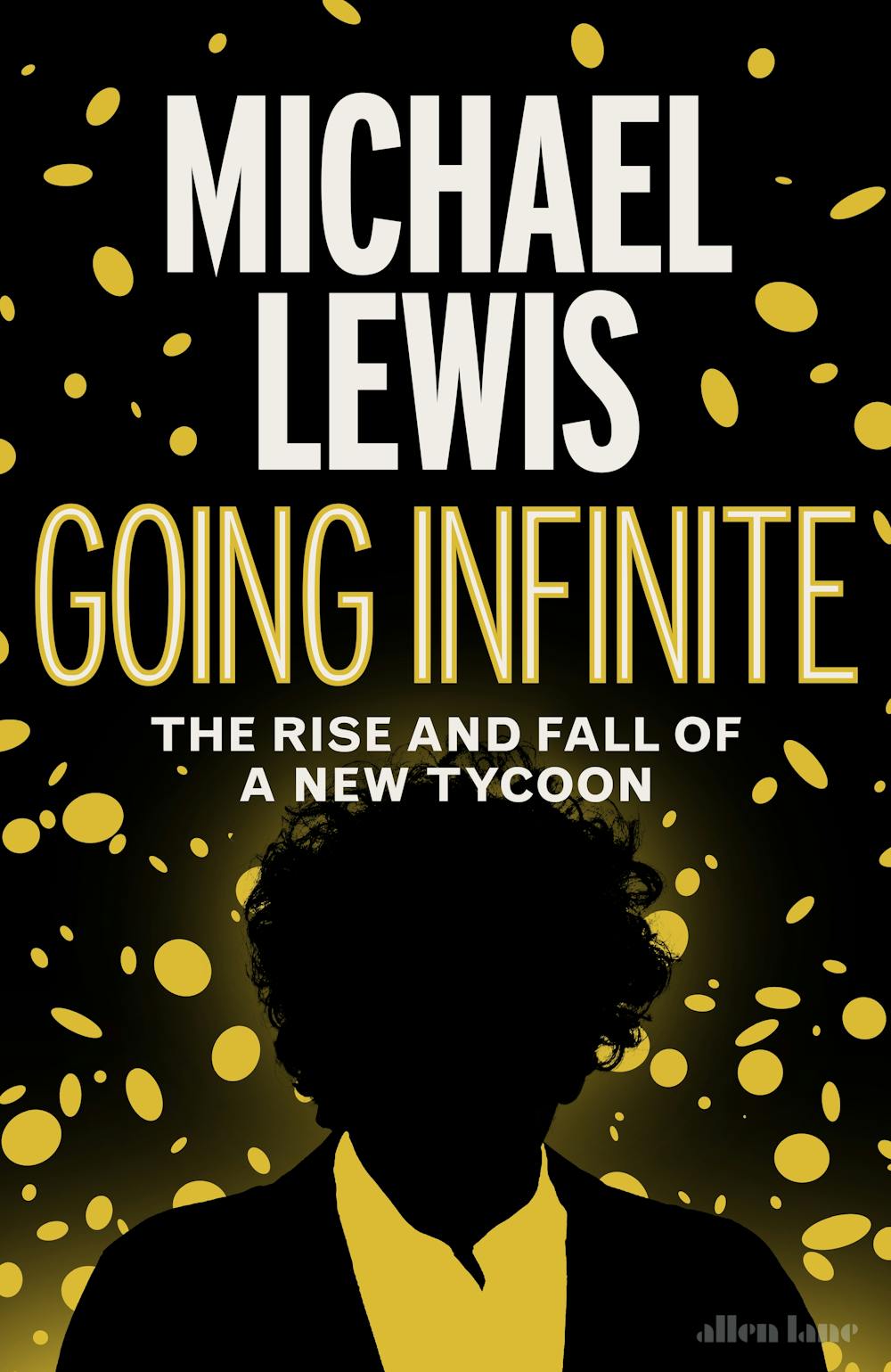
“The Blind Side” author has scored a massive payday for “Going Infinite: The Rise and Fall of a New Tycoon,” his upcoming book about the schlubby-chic son of Stanford Law school professors. Apple paid Lewis $5 million for the rights to his book, presumably to turn it into a film or limited TV series, several sources told the entertainment-news outlet. Given that Lewis spent a year embedded with Bankman-Fried, known as SBF, his book and subsequent Apple project promise a fly-on-the-wall account of Bankman-Fried and his collapsed FTX empire, “a symbol of crypto hubris gone awry,” as the New York Times said.
Lewis’ book, which marks the author’s latest coup, is scheduled to publish Oct. 3, around the time that Bankman-Fried is expected to head to U.S. District Court in Manhattan to stand trial for alleged wired fraud, commodities fraud, money laundering and related conspiracy charges…
I own and have read everything by Michael Lewis. Huge fanboy going back decades, particularly given my stint in subprime finance. I'm on the Amazon pre-order list for this new one. Stay tuned...
OCT 1 PM QUICK NOTE
Michael Lewis will be a guest on CBS 60 Minutes tonight to talk about this case. Also, prior posts on this SBF & family's self-serving "Effective Altruism" schitck here, and here.
UPDATE
_____
OTHER NEWS
A DYSKINESIAC'S DIGRESSION
Saw this in the Washington Post the other day. Given my ongoing, increasingly irksome affliction with Parkinson's Disease, I've been reading everything I could find flowing from this piece.
“No one really knows what causes Parkinson’s disease, other than about 10 to 20 percent is genetic,” said Ted M. Dawson, a professor of neurology at Johns Hopkins University School of Medicine. “Right now, the only therapies we have are symptomatic. We don’t have anything that slows the progression.”
Researchers such as Dawson have been searching for clues, and in the last two decades, a growing body of evidence points to an unexpected origin for Parkinson’s disease: the gut.
“Dyskinesia is most commonly caused by medications, such as long term use of levodopa in Parkinson's disease and use of antipsychotic medications. Dyskinesia caused by brain injury such as vascular event ( stroke) or other brain damage is less common. Movement symptoms typically start as minor shakes, tics, or tremors.”—University of Google School of Medicine
Dr. Dawson, MD, PhD (internal Med, Pharmacology), msjor league underachiever (as is his colleague spouse Valina L. Dawson, PhD). Lordy Mercy! The talent here in BMore is something else.
Interesting to me is that they both trained clinically at the University of Utah School of Medicine, Salt Lake City. I spent a lot of time in SLC across my three tenures at HealthInsight, the Utah/Nevada Medicare QIO. I wouldn't be surprised if we had mutual acquaintances. For one, Brent James, MD, M.Stat of Intermountain Healthcare (and a Baldrige Examiner) was a key mentor of mine.
Dr. Dawson heads up The Dawson Lab. Check out their "Parkinson's & the Gut" video under "recent topics" on their "Resarch" page. Very nicely done (unfortunately no embed code available).
_______
*BTW, random note: 4.09 Scaramuccis = 0.246 Friedman Units.
More to come. Gotta go watch the Ravens.
MONDAY OCT 2 UPDATE
Back briefly to the lead-in story, follow-up. Michael Lewia talks to CBS Mornings.
If you lack the time, money, or patience to carefully study the Mustafa Suleyman book, I can attest to the succinct accurate animated A/V summary provided here.
SBF on the SDNY witness stand testifying in his own defense in his FTX fraud trial.
"The biggest mistake was we did not have a dedicated risk management team, we didn't have a chief risk officer. We had a number of people who were involved to some extent in managing risk, but no one dedicated to it, and there were significant oversights."
Right. Understatement of the century thus far.
I know a thing or two about financial risk management—back in the days of actual money. From my 2008 post Tranche Warfare:
"THE BEST THINGS IN LIFE ARE'FEE'"
That was the oft-repeated sarcastic and cynical joke in executive circles at the privately held subprime VISA/MC issuer where I worked in risk management. My own initial supervisor, the hastily installed VP of Risk who'd been brought over from Collections, would candidly say in private that according our customers credit was like giving whiskey to alcoholics.
But,hey, it's legal. And, if we don't do it, someone else will.
"Churn & Burn"
I was hired initially in March of 2000 as a temp tech writer brought in to compose documentation for a pendingOCCexamination, and subsequently offered a permanent position as a "risk analyst" once they learned of my applied stats background and SAS programming fluency. When I arrived the operation was classic subprime "churn & burn," bordering on the "predatory" (some would say they'd crossed far over that border). Huge upfront and ongoing transaction fees charged to the financially desperate made it nearly impossible to lose money, heavy charge-off losses notwithstanding. Burn 'em up and churn new accounts.
At the outset of my tenure, the "Risk Department" was one effectively in name only, consisting of two holdovers of the prior risk manager'spro formaregime, one a quite saavy statistician, the other an econometrician -- both of whom had their eyes on the door.
There wasn't much "risk" to manage beyond those posed by nagging class-action litigation and pending consent decrees that were a familiar feature of the subprime domain (and cynically viewed simply as a manageable cost of doing business).
The new VP of Risk, though, set about to build an effective, "best practices" risk department, one eventually staffed by a platoon of astute MBAs and statisticians recruited from far and wide, one whose subprime credit risk modeling and portfolio management and operations analytics became the envy of the sector. The bank's portfolio and profits grew steadily and impressively, and charge-off losses declined impressively. We sailed through our regulatory examinations. The OCC eventually characterized us as "Best-in-Class"[pdf]. While most other subprime players crashed and burned during this period (including the largest issuers such as Providian and NextCard), our little bank had moved away from the reckless and predatory and into "near-prime" marketing territory...
We made successive record profits every year of the five I was there (my annual bonuses were very nice). We had financial risk by the throat. Market risk; interest rate risk; regulatory risk; reputation risk; operations risk; portfolio risk—all involving actual money rather than digital casino zero-sum table games tokens.
"The biggest mistake was we did not have a dedicated risk management team..."
Yeah, bro. In your own too-little-too-late post-crash words, "I fucked up."
BTW: Tangentially off-topic, but still, related to finance. I guess (online sports gaming).
HALLOWEEN DAY UPDATE
I've been following a number of these YouTube crypto podcasts lately. This young woman, Carly Reilly, is interesting. I have no idea as yet as to what her Sheet is.
What an old coot I am. Below, Michael Lewis at the SBF trial.
UPDATE: OF FAR MORE IMPORTANCE
The IDF bombed a northern Gaza refugee neighborhood on October 31st, killing and wounding an as-yet unknown number of Palestinian civilians. Israel claims the target was a senior Hamas commander and his subordinates. The entire apartment neighborhood was reduced to large rubble-strewn craters by a reported six large aircraft-dropped bombs.
Click image.
"...No third party is going to step into Gaza to fight the insurgency planned for Israeli troops, rebuild the infrastructure and society shattered by war, and solve the long-standing problem of governance that Hamas’s armed presence has ensured will endure. Israel is on its own, and so it must find an alternative both to leaving Gaza quickly, thereby allowing Hamas to reemerge, at least as a political entity, and to staying and battling the inevitable insurgency.
Whatever Israel decides to do now that its ground attack in Gaza is under way, it needs to understand that no deus ex machina will swoop in and save it from the accumulated consequences of its actions since 1967. When the smoke clears, yet again, Israel and the Palestinians—and not anyone else—will be left to cope with their self-inflicted disasters."
Eyeball deep in David Z. Morris at the moment, in the wake of Messrs McKenzie & Silverman. Badasses, all of them. Individually and topically in concert.
Sam Bankman Fried ("SBF")? Yeah. Lordy. Been there, done that.
DAVID BEGINS:
I spent almost every weekday in October of 2023 in a courtroom in Lower Manhattan, listening to experts, lawyers, and first-hand witnesses recount the collapse of the FTX cryptocurrency exchange and prove Sam Bankman-Fried’s responsibility for it to a jury.
But while this book recounts Bankman-Fried’s crimes in detail, it is ultimately focused on his ideas. Bankman-Fried, for a time known affectionately as “SBF,” was deeply tied to concepts and movements with names like Effective Altruism, determinism, utilitarianism, extinction risk, Rationalism, and longtermism.
These buzzwords have been developed into increasingly formal systems by professional philosophers and ethicists at elite universities, and further amplified through a network of institutions well-funded by technology billionaires. But they stand for much deeper, much older structures of thought: a historical teleology that I here call “techno-utopianism.”
The superficial optimism of Effective Altruism was fundamental to the public fascination with Bankman-Fried that helped fuel his lightning-fast ascent. But its deeper biases — to which he was perhaps uniquely vulnerable — also helped Bankman-Fried rationalize his crimes, and its superficial logics created the blind spots that led to his downfall.
This book is not a work of journalism, but of forensic philosophy. It asks how techno-utopian ideas, so loudly declaring their intent to do good, instead led to one of the largest financial frauds in American history — and whether their broader sway in twenty-first-century politics and society may lead to similar results, on a much larger scale.
Morris, David. Stealing The Future: Sam Bankman-Fried, Elite Fraud, and the Cult of Techno-Utopia (pp. 8-9). (Function). Kindle Edition.
UPDATE
Sam Bankman-Fried's mother has recently submitted a 64-page appeal brief on her son's behalf:
I am a law professor at Stanford, where I have taught for close to forty years. Before that, I was a practicing lawyer in New York and clerked on the Second Circuit Court of Appeals. I am also Sam Bankman-Fried’s mother. Because of my professional life, I have witnessed the events of the past three years through two very different sets of eyes. Someday I may write about what it has been like to live through this experience as a parent. Today I write as a lawyer, about the government’s legal case against Sam and the other FTX defendants. I would have much preferred to leave this task to others. But the spectacle that has surrounded the FTX case since day one has not been conducive to serious, independent thought or attention to facts. It has also imposed a very high cost on anyone who publicly expressed doubts about whether justice has been done in this case. I hope this will change in time, and others will come forward to supplement or amend what I have written here. Most of what I say below is documented in the trial transcript and public records posted on the official court docket. I have provided cites for those who would like to follow up on their own…
Many observers see a fairly obvious Trump pardon effort ploy here. The further along I get in David's book, the more I tend to agree.
____
More broadly with respect to FinSec / crypto fraud, we must not forget our Sorkin. Andrew interviewed SBF remotely via Zoom for his "Dealbook" program in the wake of the FTX crash. David's analytic recounting of that conversation is riveting.
"But with all I don't know, you could fill up a library."
.
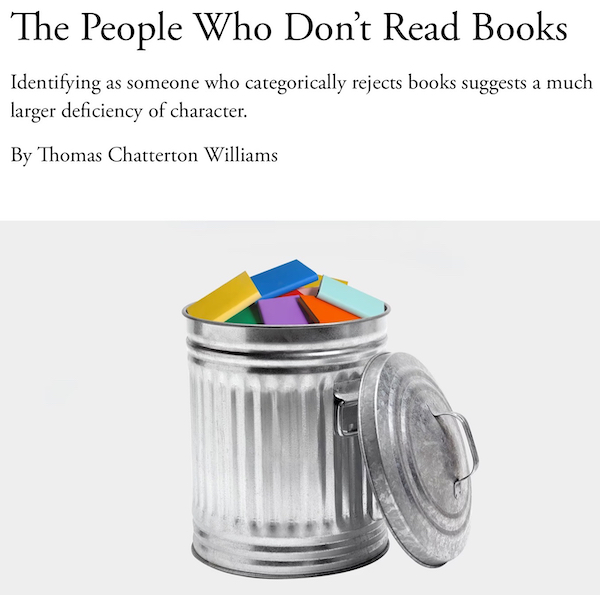
I found the blog post title quote in this Atlantic article by Thomas Chatterton Williams.
When I was in my 20s and writing my first book—I know, I really fucked up there—I came across a quote I can no longer find the source of that said, essentially, “You could fill a book with all I know, but with all I don’t know, you could fill a library.” It’s a helpful visualization, perhaps the most basic and pragmatic justification for deep reading. And though correlation is not causation, I submit that we’d save ourselves an enormous amount of trouble in the future if we’d agree to a simple litmus test: Immediately disregard anyone in the business of selling a vision who proudly proclaims they hate reading...
Tweeted him to tell him I'd be "stealin' it."
We have never before had access to so many perspectives, ideas, and information. Much of it is fleetingly interesting but ultimately inconsequential—not to be confused with expertise, let alone wisdom. This much is widely understood and discussed. The ease with which we can know things and communicate them to one another, as well as launder success in one realm into pseudo-authority in countless others, has combined with a traditional American tendency toward anti-intellectualism and celebrity worship. Toss in a decades-long decline in the humanities, and we get our superficial culture in which even the elite will openly disparage as pointless our main repositories for the very best that has been thought.
…In an ill-conceived profile from September, published on the Sequoia Capital website, the 30-year-old SBF rails against literature of any kind, lecturing a journalist on why he would “never” read a book. “I’m very skeptical of books,” he expands. “I don’t want to say no book is ever worth reading, but I actually do believe something pretty close to that. I think, if you wrote a book, you fucked up, and it should have been a six-paragraph blog post.”…
It is one thing in practice not to read books, or not to read them as much as one might wish. But it is something else entirely to despise the act in principle. Identifying as someone who categorically rejects books suggests a much larger deficiency of character …. receiving all of your information from the SBF ideal of six-paragraph blog posts, or from the movies and random conversations that Ye prefers, is as foolish as identifying as someone who chooses to eat only fast food.
Many books should not have been published, and writing one is an excruciating process full of failure. But when a book succeeds, even partially, it represents a level of concentration and refinement—a mastery of subject and style strengthened through patience and clarified in revision—that cannot be equaled. Writing a book is an extraordinarily disproportionate act: What can be consumed in a matter of hours takes years to bring to fruition. That is its virtue. And the rare patience a book still demands of a reader—those precious slow hours of deep focus—is also a virtue. One might reasonably ask just where, after all, these men have been in such a rush to get to? One might reasonably joke that the answer is either jail or obscurity…
Great article.
"...when
a book succeeds, even partially, it represents a level of concentration
and refinement—a mastery of subject and style strengthened through
patience and clarified in revision—that cannot be equaled. Writing a
book is an extraordinarily disproportionate act: What can be consumed in
a matter of hours takes years to bring to fruition. That is its virtue.
And the rare patience a book still demands of a reader—those precious
slow hours of deep focus—is also a virtue..."
I continue to read for at least 30 hours a week, averaging 2-3 books a week plus all of my periodicals. There's just too much to learn and unlearn. 'Nuther fav quote of mine: "The best place to hide a $100 bill from Donald Trump is inside a book."
Just finished this one.
Stay tuned. Not yet sure about this one. It piqued my interest in light of my 1998 Master’s in Applied Ethics ("Ethics & Policy Studies") and my ongoing Jones for so-called "Deliberation Science."
UPDATE: ANOTHER BOOK JUMPS THE QUEUE
Read this New Yorker article the other day. Led me to this book. Had to get it. Delightful thus far.
Early on, some "Taylorism 2.0" observations (I've taken my shots at Taylor across the years. I'm one of those humanistic progressive QI guys):
...Sometimes, digital enforcement happens through attempts to prevent violation, making rules more difficult to break—using code to make it more onerous (or even impossible) to deviate from an imposed rule. For example, digital rights management technology makes it (nearly) impossible to violate copyright law. If these technologies work as “perfectly” as intended, rule violation is completely impaired, and violation becomes practically impossible (or at least much more difficult). But even more common than tools of prevention are tools of detection—technologies that function not by making rule-violating behavior more difficult to execute, but by creating a comprehensive account of our behaviors. These are surveillance technologies. For example, body-worn cameras don’t make it impossible for a police officer to use unauthorized force against a civilian, but are intended to make the officer more accountable should they do so. These technologies may work by deterring sanctioned behaviors—knowing that one is being observed can incentivize rule-following—or because they enable enforcers to more swiftly detect and punish rule-breaking.
Perhaps nowhere do we see this trend more clearly than in the workplace, where surveillance over workers’ behaviors has become a favored method for compelling compliance with the aims of management. As we’ll see, this practice has deep roots—but contemporary workplace surveillance has some new features, too.
Work and the Future of Work We often anticipate the “future of work” in either dreamy or dystopian terms. The phrase has been widely adopted by technologists and commentators, either to describe a paradisical ideal in which people have much greater autonomy and flexibility to do work in ways that suit them while affording them ample time for leisure; or, as a dark alternative, as a future in which workers have ever-diminishing social and economic power and in which their every move and thought is overseen, predicted, and optimized by management, human or algorithmic. Both visions, though, are united by the assumption that the future of work (whatever it looks like) will happen, well, in the future—that is to say, this is a vision of a time that is not now, and that is somehow different than now, or at least different enough that it deserves its own label.
It’s rather curious that we tend to talk in such future-oriented prognostications about what technological change will portend for work and the workplace. In other domains, the way we talk about technology tends to be more focused on what is occurring now or in the very near term; but when it comes to work, we maintain some temporal distance, at least in our discourse, from these changes. This is odd because the “future of work” is, of course, not some distant or discrete mode of social organization so unlike the one we have today. The management practices of tomorrow are, in many ways, not particularly different from the management practices of the past. They’re built on the same foundations—motivating efficiency, minimizing loss, optimizing processes, improving productivity. And one of the most common strategies for achieving these goals, then and now, is increased oversight over the activities of workers.
So what's new about today’s workplace surveillance? Is this not just more of the same, driven by the same organizational goals that have always motivated managerial oversight—even if the specific technologies that are used to do so have changed form in one way or another? Some workplace monitoring is old wine in a new bottle, a contemporary instantiation of the manager with a clipboard looming above the factory floor. This is not to say, of course, that these practices don’t deserve scrutiny or critique—but we should be precise about what, if anything, is new here.
In fact, there are some subtle but important dynamics that distinguish contemporary workplace surveillance from what’s come before, and that will become important in telling the truckers’ story. First, contemporary technologies facilitate surveillance in new kinds of workplaces. Geographically distributed and mobile workers, for example, have historically maintained more independence from oversight than workers centralized in nonmobile workplaces, like factories, call centers, and office buildings—but location tracking, sensor technology, and wireless networking have changed that. Porous boundaries between home and work also facilitate surveillance in new places. For example, the growth of work-from-home arrangements during the Covid-19 pandemic has led to greater use of tracking software to monitor workers’ keystrokes, locations, and web traffic—as well as video capture of the kitchen tables and living rooms in which their work now takes place.
New kinds of data also come to the fore. As sensor technologies become cheaper and easier to deploy, and workplace surveillance capability is more frequently embedded in software by default, employers are well positioned to capture more and more fine-grained data about workers’ movements and activities. Wearable technologies, like those used in Amazon’s warehouses, monitor and evaluate workers’ speed with much more precision than was previously possible—including the number and length of their bathroom breaks. Employers increasingly monitor and analyze datapoints like workers’ social media posts, phone calls, and attendance at meetings; Microsoft faced pushback in 2020 when it built “productivity scoring” into its widely used Office 365 product, which gave managers access to “73 pieces of granular data about worker behavior” like email and chat frequency. And as we’ll discuss, biometric data is also becoming more commonly collected in the workplace—from authentication mechanisms like fingerprint and retinal scans to behavioral data about workers’ attention and fatigue.
These new data streams fuel new kinds of analysis that impact how workers are managed. In some contexts, managerial decisions are implemented through opaque algorithmic systems that can create acute information asymmetries between workers and firms—like Uber’s use of algorithms to apportion rides and determine rates without making those rules transparent to its drivers. Other analyses are predictive, designed to forecast which workers are likely to be most productive, how many workers to staff at a given time to meet demand, or which worker is likely to make a sale to a particular customer.
Finally, contemporary workplace surveillance can blur boundaries between the workplace and other spheres of life, creating new kinds of entanglements across previously disparate domains. Surveillance of work-from-home environments can facilitate data collection about family, friends, and living situations. Managers often keep tabs on workers’ online activities on social media platforms. Workplace wellness programs can facilitate employers’ collection of data about worker health, stoking concerns about discrimination. And “bring-your-own-device” policies, in which an employer’s software is installed on a worker’s own personal phone or computer, can further muddle distinctions between home and work and create additional data privacy and security concerns.
Scary smart. Law Degree and a Doctorate in Sociology from Princeton. What a Sheet (pdf).
Just guessing, based on her CV, she may be about 40 ( no personal bio info). But, I gotta say, were I a bartender and she came in, I'd be asking for ID.
Younger brother Gabe's $3.3 million DC "charity" digs.
sbf
Gabe Bankman-Fried—younger brother of the disgraced FTX founder, Sam Bankman-Fried—purchased a $3.289 million Capitol Hill townhouse in April. The deal was made through Gabe's nonprofit, Guarding Against Pandemics. The organization, aimed at preventing another pandemic, was partly funded by SBF. The move to the US capital was meant to send the message that the FTX founder "and his network were in DC to stay," according to a report from Puck.
Just one week before FTX's collapse, Guarding Against Pandemics hosted back-to-back cocktail parties for high-ranking Democrats and Republicans, the New York Post reported.
The four-story townhouse comes with four bedrooms, four-and-a-half bathrooms, two private terraces, and an elevator, according to a listing for the property from real estate company Bright MLS…
Yeah. Of course.
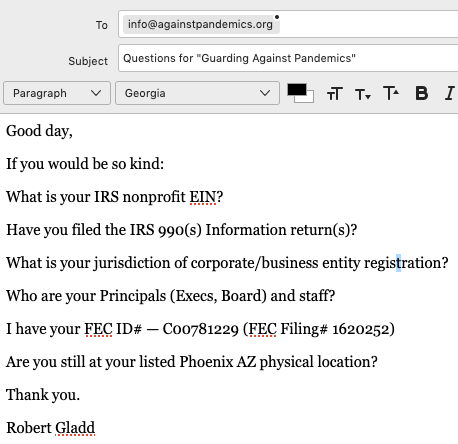
OK, nothing on their website regarding Board of Directors or staff. A Guidestar.org search turns up nothing at all (you look there for things such as the annual IRS Form 990 non-profit information returns that set forth revenue, expenses, salaries of Principals, compensation of outside entities, etc). I rather doubt we'll readily find any legit incorporating documentation here. Across my life, I've founded and administered three for-profit corporations (two Sub-S and a C-Corp), as well as a 501(c)(3) non-profit charity, and 501(c)(6) "professional organization" non-profit (all on my own without lawyers). I know what to look for and where it should be found.
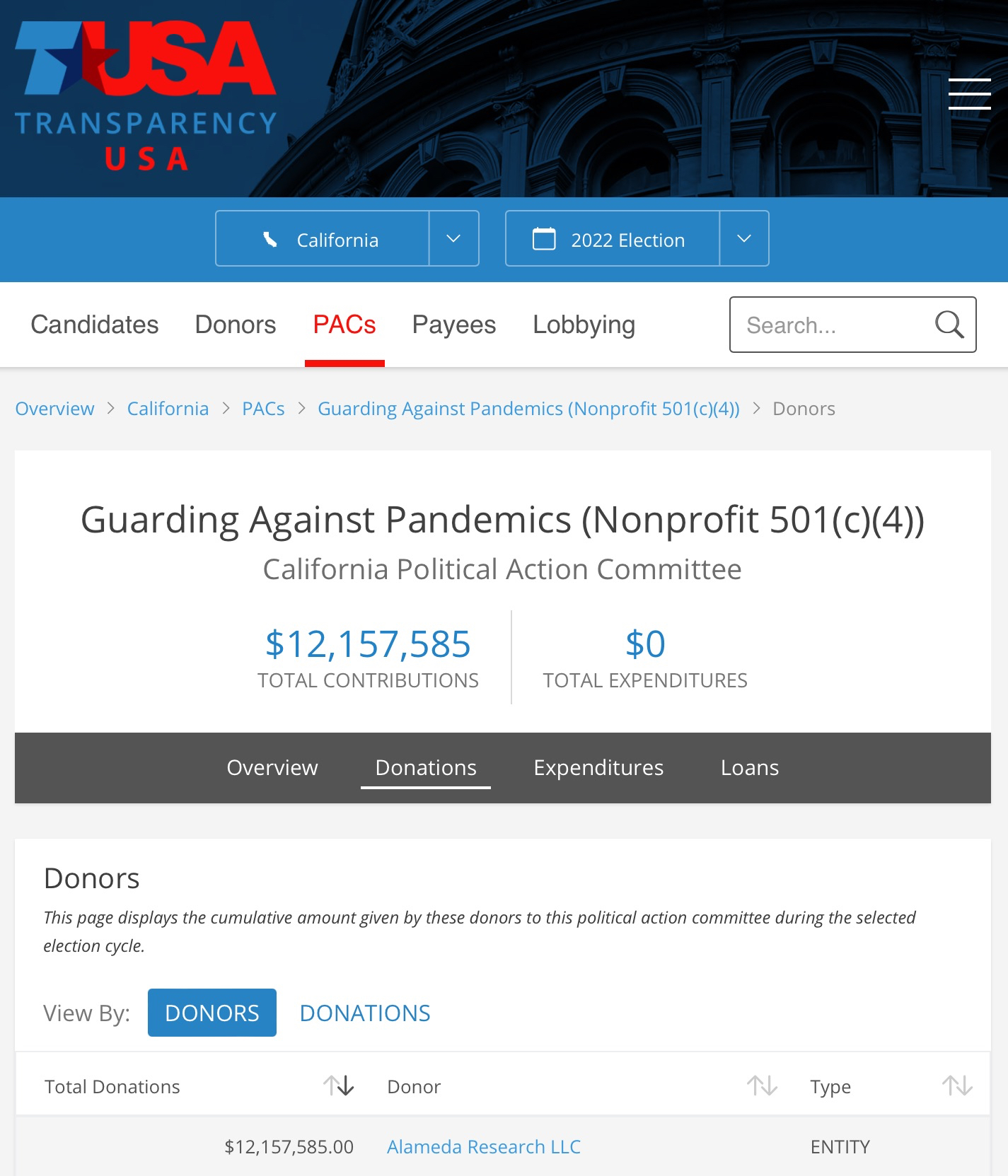
This is a "PAC" (Political Action Committee), not a 501(c)(3) public service "charity." Imagine our surprise.
It'd be nice if actual professional investigative reporters (and regulatory authorities) would peek into this. Ya think?
UPDATE: Search of the Arizona Secretary of State's business & charities database comes up empty. Unsurprisingly. Be interesting to know the jurisdiction of registration.
MORE
No corporate SoS listing in California either. A search of the IRS site fails to find their 501(c)(4) EIN and related information.
So, Gabe's PAC got a $12,157,585 "donation" from his brother's "Alameda Research." Nothing fishy there...
A year ago, Sam Bankman-Fried (often called “SBF”) was on top of the world. He had been on the covers of Forbes, which dubbed him “the richest twentysomething in the world”, and Fortune – the equivalent, for a business leader, of a rock star on Rolling Stone, or an athlete on Sports Illustrated.
But in late 2022, his FTX crypto trading operation – and the closely related Alameda Research, an investment fund he had founded before FTX – both collapsed.
Bankman-Fried is currently charged with crimes relating to the disappearance of billions of dollars of FTX users’ money. These people did not think they were investing in FTX, or even lending to it. Their funds were just being kept there while they switched between, for example, dollars and bitcoins or between bitcoins and dogecoins. But instead it is claimed that their funds were transferred to Alameda and then lost.
Bankman-Fried is pleading not guilty and has published a statement reading: “I didn’t steal funds, and I certainly didn’t stash billions away.”
Review: Going Infinite: The Rise and Fall of a New Tycoon – Michael Lewis (Allen Lane)
Bankman-Fried, who was living in the Bahamas at the time of his arrest, now resides in a US prison. He is facing charges that could result in a sentence of more than a century behind bars and has been taunted as “Scam Bankrupt-Fraud”.
His remarkable story has been told by Michael Lewis, the author of Liar’s Poker, a Wall Street story drawing on his own experience as a bond salesman for Salomon Brothers; and the internationally successful book-then-film The Big Short, an account of the financial market shenanigans that led to the global financial crisis of 2007-09.
Lewis, who had extraordinary access to Bankman-Fried while writing, holds the unusual combination of degrees in art history from Princeton and economics from the London School of Economics. As a former bond salesman, he knows his way around financial markets and has seen his share of excess and oversized egos. As a journalist, he is skilled at clear writing about complex finance. He was ideally placed to write this book.
However, he has been widely criticised as too close to his subject. When Bankman-Fried was arrested, Lewis had been shadowing him for nearly a year. And as events unfolded – and even while Bankman-Fried was under house arrest – Lewis was there, taking notes.
Going Infinite derives its title from a question Lewis asked his subject: how much would he need to be paid to sell and walk away from FTX? Bankman-Fried initially replied: $150 billion. He then added he needed “infinite dollars” because he planned to address existential risks facing humanity.
Making the cover of Forbes is the equivalent, for a business leader, of a rock star on Rolling Stone.
This rather grandiose response was based on a concept called “effective altruism”, inspired by a 1971 essay by Australian philosopher Peter Singer.
Lewis’s example is that instead of becoming a doctor in Africa and helping some people, you can make a fortune and then pay for 40 doctors and help 40 times as many people.
Bankman-Fried claimed his motivation for FTX was to fund effective altruism. Some of his senior executives claimed to share this motivation.
Bankman-Fried felt Donald Trump was an impediment to actions that would make the world a better place. He donated to anti-Trump Republicans and to Democrats. One revelation in the book is that Bankman-Fried contemplated paying Trump not to run again for president. The figure mentioned was US$5 billion, but it is not clear whether this number came from Trump himself.
The odd life of Sam Bankman-Fried
Bankman-Fried’s parents are both Stanford professors. But there is no obvious factor in his childhood that explains his eccentricities, or why he seemed to have few friends.
Lewis writes that Bankman-Fried had to teach himself facial expressions, and that Bankman-Fried thought he had “an aching hole in my brain where happiness should be”. He skates over Bankman-Fried’s years as a high school nerd, where the place he most felt a kind of belonging was math camp, and as a MIT physics student. And he concludes that the future crypto king was perfectly positioned, emotionally and intellectually, to make a religion of himself.
One of the most interesting parts of the book is the account of Bankman-Fried’s early career at Jane Street Capital, a Wall Street high-frequency trading firm, where interns were encouraged to gamble with each other and with the full-time employees as a way of developing their professional skills. There, Bankman-Fried’s intuition about probability shone.
The “SBF” who emerges from the book has some similarities with the portrait of Elon Musk in the eponymous just-published biography by Walter Isaacson. Both men are convinced they are the smartest guy in any room they are in. And both have the hubris to think the future of humanity depends on them.
Bankman-Fried reportedly said there was a 5% chance he could become US president. The US constitution meant this was one takeover to which the South Africa-born Musk could not aspire.
Isaacson relates a half-hour telephone discussion between Bankman-Fried and Musk about the latter’s takeover bid for Twitter. After consulting colleagues for 15 minutes, with Lewis present, Bankman-Fried was considering contributing “maybe a billion” as part of a consortium being assembled by Musk. But the discussion did not go well. Both apparently thought the other was crazy.
This Forbes video purports to take readers behind the scenes of FTX in the Bahamas.
FTX was ‘essentially a casino’
So-called “cryptocurrencies”, like Bitcoin, are rarely used for their original stated purpose of making payments. They are really just speculative tokens with no fundamental value.
FTX promoted itself as the equivalent of a stock exchange for these cryptocurrencies.
Lewis writes:
The new crypto exchanges had no regulators. They acted as both exchange and custodian: they didn’t just enable you to buy bitcoin but also housed the bitcoin you’d bought.
FTX was no usual business operation. It was barely a business at all. FTX had no chief financial officer, nor even a list of its staff. It had a sort of board of directors, just for appearances. Bankman-Fried was one director, but in a conversation with Lewis, he could not recall the other two. As Lewis puts it, he “just thought grown-ups were pointless”.
Most of the senior staff at FTX and Alameda were friends of Bankman-Fried (although many have since turned on him, whether from a belated sense of shame or to try to wrangle shorter prison sentences). They lived and worked in a luxury compound in the Bahamas, a sunny place for shady people (as Somerset Maugham once described Monaco).
Apart from the luxury accommodation, there were other extravagances, such as food and chartered planes. Clothes were not one of them. Until his recent court appearances, Bankman-Fried was rarely seen in anything but a t-shirt and shorts - no matter the occasion.
One of his senior employees, Zane Tackett, told Lewis:
His oddness mixed with just how smart he was allowed you to wave away a lot of the concerns. The question of why just goes away.
FTX was essentially a casino. But Bankman-Fried both owned the casino and was gambling in it – apparently with other people’s chips. Alameda Research seemed to be making large bets with money transferred from the accounts of FTX customers.
While Alameda operated in the shadows, huge amounts were spent promoting FTX.
FTX spent tens of millions making an expensive advertisment featuring Larry David comparing crypto to the wheel, democracy and the moon landing. (It has already been screened at the trial.) At least, unlike Katy Perry, Larry can claim that in the advert he was sceptical!
The gag of this expensive ad for FTX, featuring a sceptical Larry David, is now reversed.
After FTX collapsed, John Ray, the bankruptcy expert tasked with sorting out the mess, remarked: “Never in my career have I seen such a complete failure of corporate controls and such a complete absence of trustworthy financial information.” And he had handled Enron!
Accused of having stolen billions
Somewhere between US$5 billion and US$10 billion of customers’ money from FTX seems to have disappeared. Lewis writes that it may have been lost in losing bets by Alameda. Lewis estimates that Bankman-Fried made over 300 separate investments - one every three days. There were certainly some poor investments, such as 101 Bored Ape NFTs, bought for US$24 million. These have lost about 90% of their value.
Bankman-Fried has been accused of having stolen “billions from thousands of people”. His lawyers responded that he is being painted as a “cartoon villian”. A lot will depend on whether the jury regards him as a calculating liar or an idiot savant “math nerd”, hopelessly out of his depth as a manager.
Another interesting aspect yet to emerge is how the top Wall Street and Silicon Valley investors explain their naivety in trusting Bankman-Fried. How do you explain what the Financial Times called the “legend of Sam”?
Michael Lewis has written ‘a letter to the jury’
Lewis seems inclined towards the view Bankman-Fried may not have been deliberately fraudulent. He has spoken of a “mob mentality” and a “very quick rush to judgement”.
Biographers seem to sometimes experience a literary equivalent of the now much-debated “Stockholm syndrome”. If they are embedded with their subject, they may come to share their world view.
Another recent book that profiles Bankman-Fried, Number Go Up by Zeke Faux, paints a similar picture in many ways – but is more sceptical about his motivations.
Faux makes the telling point that many of the punters lured in by the advertisements for FTX lost money they could not afford to lose. This is hardly the act of an altruist. Faux described Lewis as asking his subject questions “so fawning, they seemed inappropriate for a journalist” at an FTX-sponsored conference.
Like Lewis’s other books on financial shenanigans, Going Infinite does a good job of explaining complex financial concepts. And it is an entertaining read about an unusual and intriguing personality. But it does seem like it was rushed out to coincide with the trial. There is no index, for example. It will need a second edition once the current court case is resolved.